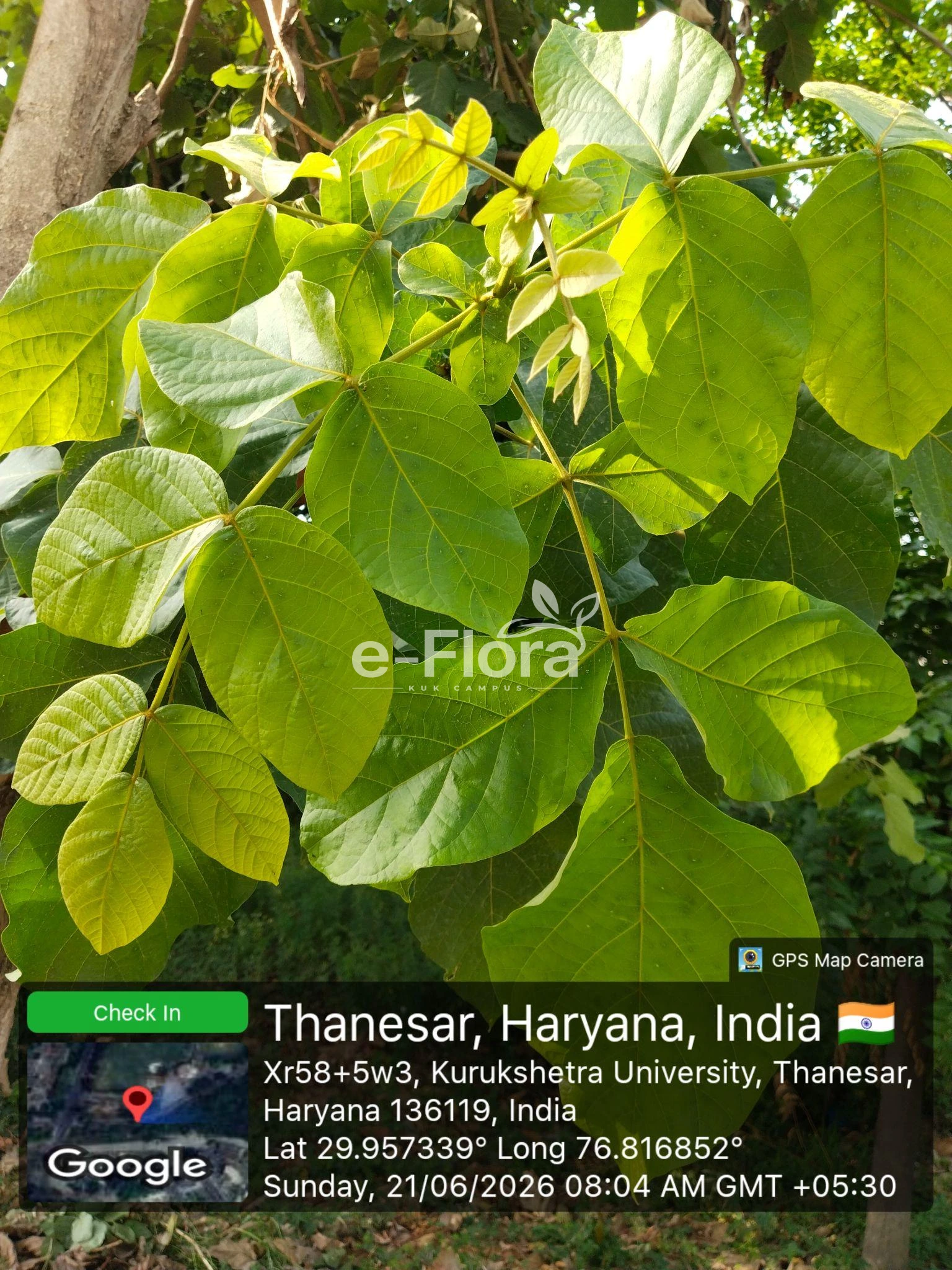
Populus alba L.
Vernacular name: White poplar, Silver poplar (Hindi: सफेद पेड़)
Species Name: Populus alba L.
Family: Salicaceae
Habit: Deciduous tree
Stem: Stout trunk, smooth greenish-white bark with diamond lenticels.
Leaf: Alternate, ovate to 3-5 lobed, dark green above, white-felted below
Flowering: March-April
Flowers: Dioecious pendulous catkins; males silvery silky; females green cylindrical; floral scales dentate; staminate flowers with numerous stamens
Fruit: Capsule catkins, cottony seeds
Uses:
- Bark has anti-inflammatory, antiseptic, diuretic and febrifuge properties.
- Bark has salicin used to synthesize aspirin and helps with arthritis, rheumatism and fever.
- Bark is also used to treat back pain, gout, menstrual cramps and digestive issues.
- Extracts are applied to help with haemorrhoids, sprains and infected wounds.
- Leaves have antimicrobial, antifungal and antioxidant properties.
- Wood is easily carveable and used to make matches, plywood, boxes, renaissance panels, paintings and sculptures.
- Planted for coastal dune stabilization, windbreaks and shelterbelts as it is salt tolerant and has deep extensive root system. It also planted near water meadows as ornamental plant due to its green and white leaves.
- Inner bark can be powdered to mix with flour.
- Shoots soaked in water can act as natural rooting hormone.
- It is a Riparian pioneer and suckers aggressively.
- It is also known as Roman “arbor alba”.