


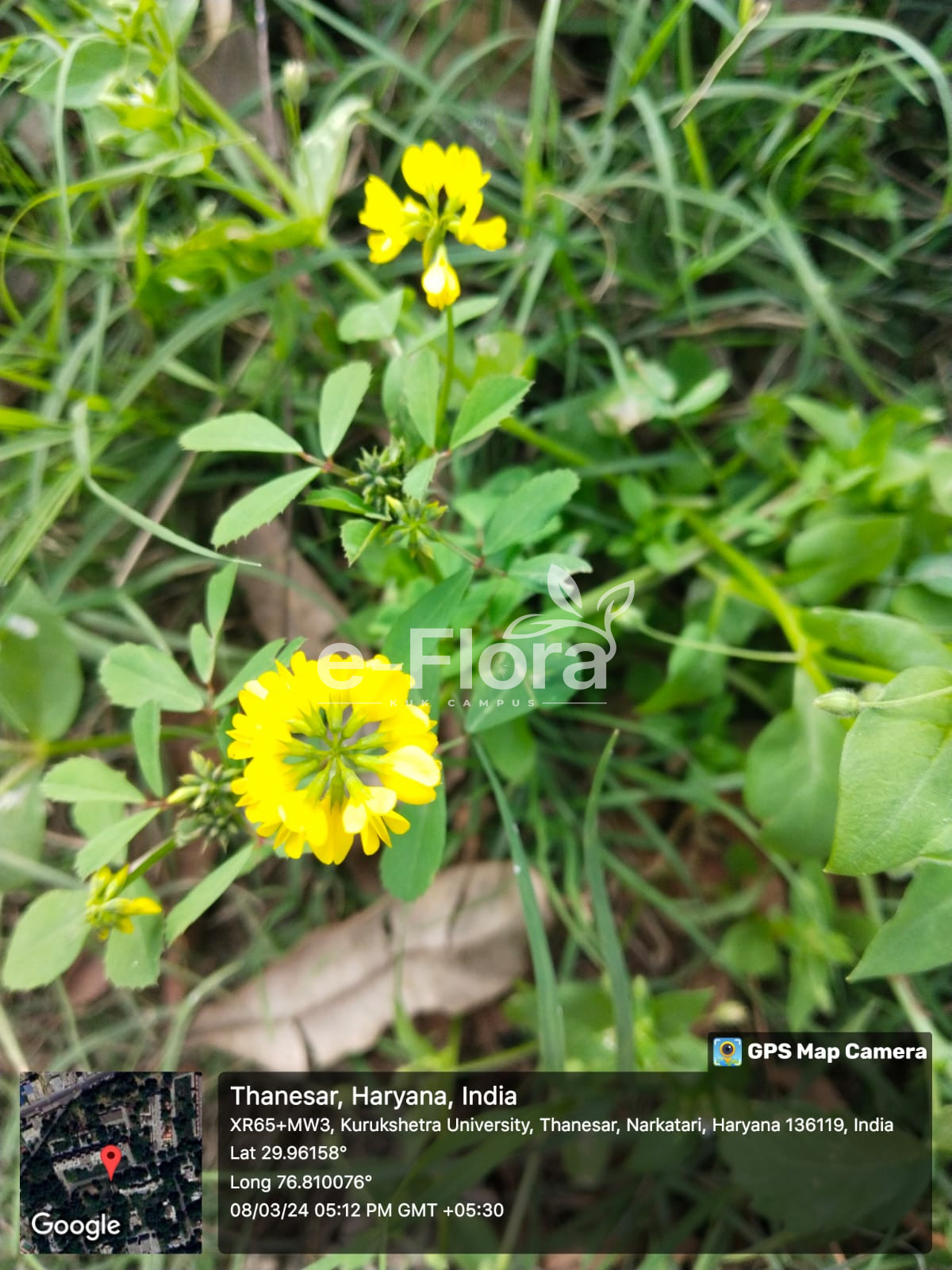

Trifolium campestre Schreb.
Vernacular names: Great Hop Trefoil, Hop Clover, Hop Trefoil, Large Hop Clover
Species Name: Trifolium campestre Schreb.
Family: Fabaceae (Leguminosae)
Habit: Annual, erect to ascending herb.
Stem: Slender, erect or ascending, usually hairy and branched.
Leaf: Leaves trifoliate and pinnately arranged; lateral leaflets are nearly sessile while the terminal leaflet has a distinctly longer stalk. Leaflets are obovate, usually emarginate/retuse at the apex, with margins entire below and serrate toward the upper portion.
Flowering: Mainly during the warmer part of the growing season
Flowers: Numerous small yellow flowers arranged in rounded to ovoid, sometimes cylindrical, head-like racemes. The yellow corolla is persistent and becomes brown/straw-coloured as the fruit develops, which is a particularly useful identification character.
Fruit: Small legume enclosed by the persistent, browning corolla/calyx; seeds are small and typically one or few per pod.
Uses:
- Plant contains bioactive secondary metabolites like flavonoids and phenolic acids which contributes to antioxidant property of hop clover plant.
- Nutritious foliage can be used as animal food and when found in pastures, can be palatable for grazing livestock.
- It is used as cover crop that also acts as green manure by naturally fixing nitrogen in soil and improve soil quality.
- Small yellow flowers attracts various beneficial insects and birds of pollination like honey bee.
- In some regions, green plants parts are used in salads or brewed into herbal teas and seeds are roasted.