Withania somnifera (L.) Dunal
Vernacular name: Ashwagandha, Asgandh, Indian ginseng, Winter cherry (Hindi: अश्वगंधा, असगंध)
Species Name: Withania somnifera (L.) Dunal
Family: Solanaceae
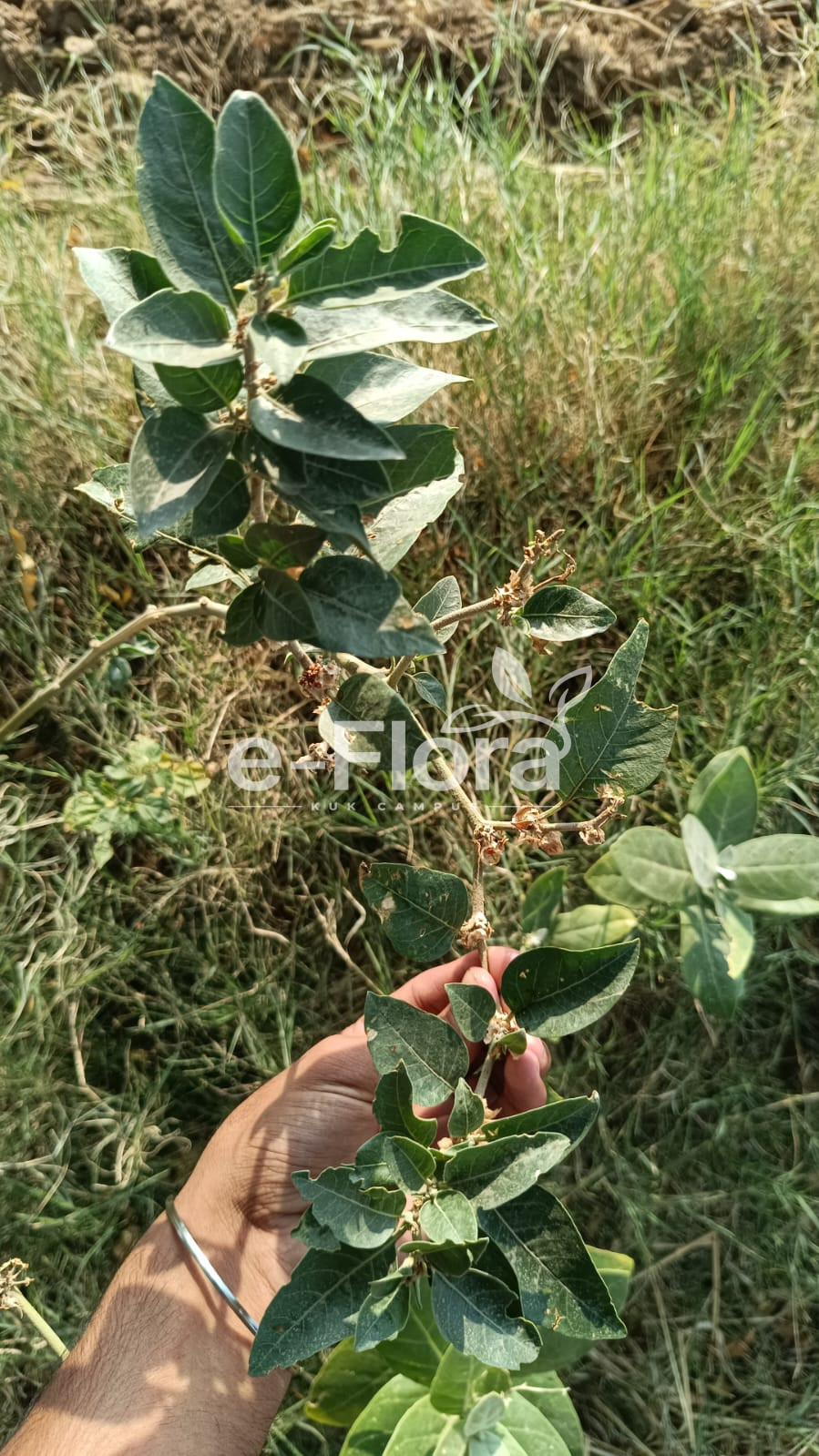
Habit: Perennial undershrub, usually 30–150 cm tall, much-branched.
Stem: Erect or spreading, grey-green, terete, densely covered with whitish woolly/tomentose hairs.
Leaf: Simple, alternate or sometimes appearing opposite near inflorescences, ovate to oblong, entire, petiolate, densely hairy beneath.
Flowering: Mainly throughout the warm season; in India flowering and fruiting may occur for much of the year.
Flowers: Small, axillary, usually in clusters of 3–6; greenish-yellow, campanulate, 5-lobed; stamens 5; ovary superior.
Fruit: Globose berry, about 5–10 mm diameter, green when immature and orange-red/red when ripe, enclosed by the enlarged papery calyx.
Uses:
- The roots are the principal medicinal part and have been used traditionally in Ayurveda and Unani medicines for thousands of years. The plant is cultivated commercially as a medicinal crop, and the dried root is commonly prepared as a powder or other herbal preparation.
- Ashwagandha acts as adaptogen and helps body adapt to physical and mental stress.
- Traditionally, ashwagandha is used as a sedative to manage insomnia and calm the nervous system.
- Daily consumption is useful in enhancing muscle strength, stamina and recovery after exercise as it acts as a rejuvenating agent.
- Ashwagandha stimulates or modulates immune responses, support memory, focus and neuroprotection.
- Ashwagandha is used to treat leukoderma, painful swellings, weakness, ulcers, men sterility by increasing levels of testosterones, increases seminal motility and decrease cortisol levels.
- Leaf paste is used to treat tubercular gland inflammation where as roots helps with skin diseases, dyspepsia, bronchitis and eye diseases. Bark infusions are used in treatment of asthma.
- Plant has anti-inflammatory, anti-tumor, antibacterial, anthelmintic, antifungal, anti-stress, anti-convulsant, antipyretic and immunomodulatory properties.
- Ashwagandha can alter thyroid hormone, cause adverse pregnancy outcomes if not use with caution.
- Robust tap-root system helps with the prevent of soil erosion and its ability to thrive in arid soils makes it a good choice as pioneer plant for reclamation of degraded drylands. Fallen leaf litter and residual plant biomass decomposes to enrich soil with organic matter.
- Orange-red barriers serves as a nutritive food source for local frugivorous birds that helps with seed dispersal.
- Presence of withanolide content gives bitter taste to foliage combined with stellated hair coating makes it fodder for selective animals like goats, that assists with pastoral seed dispersion.