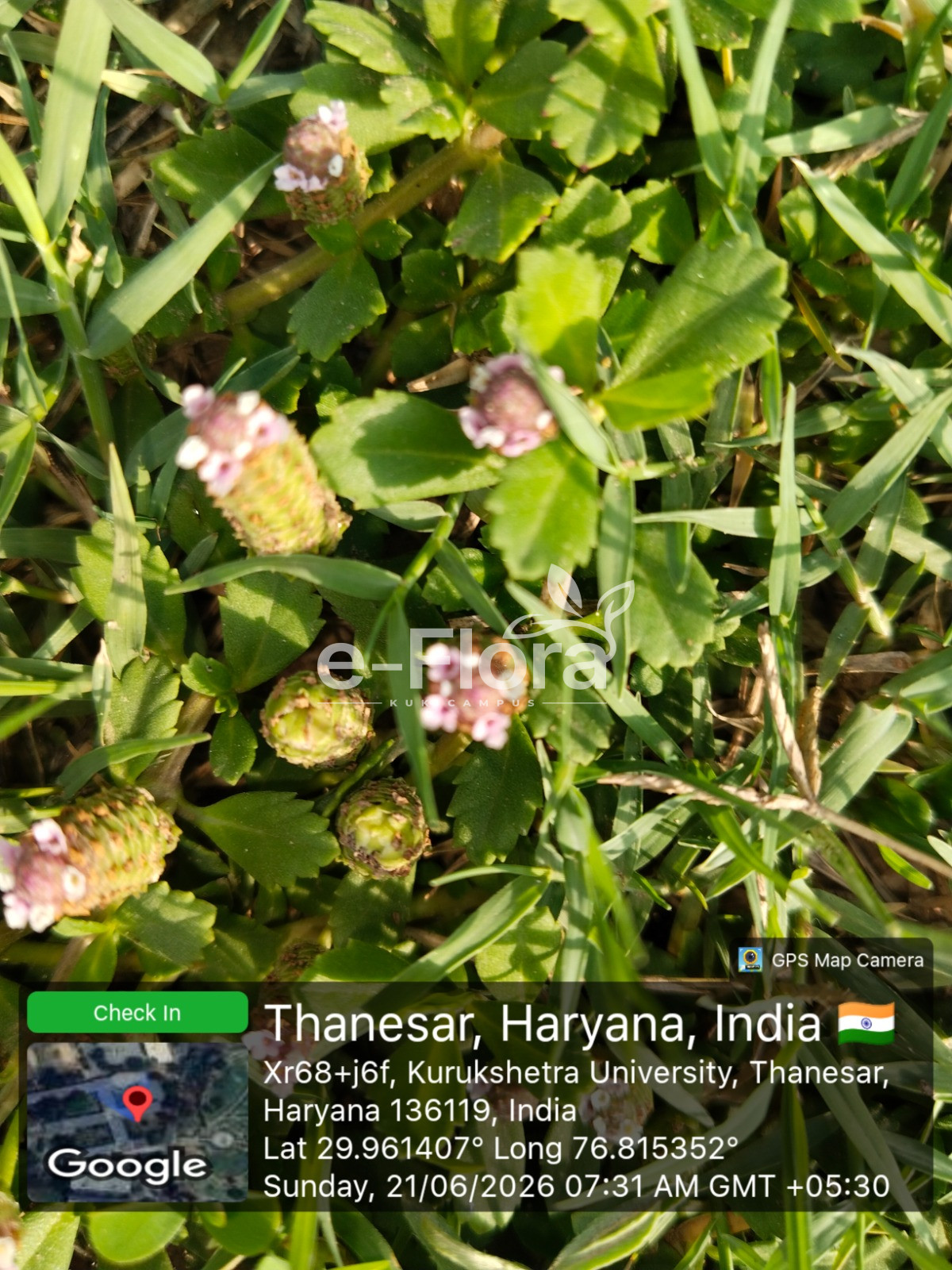
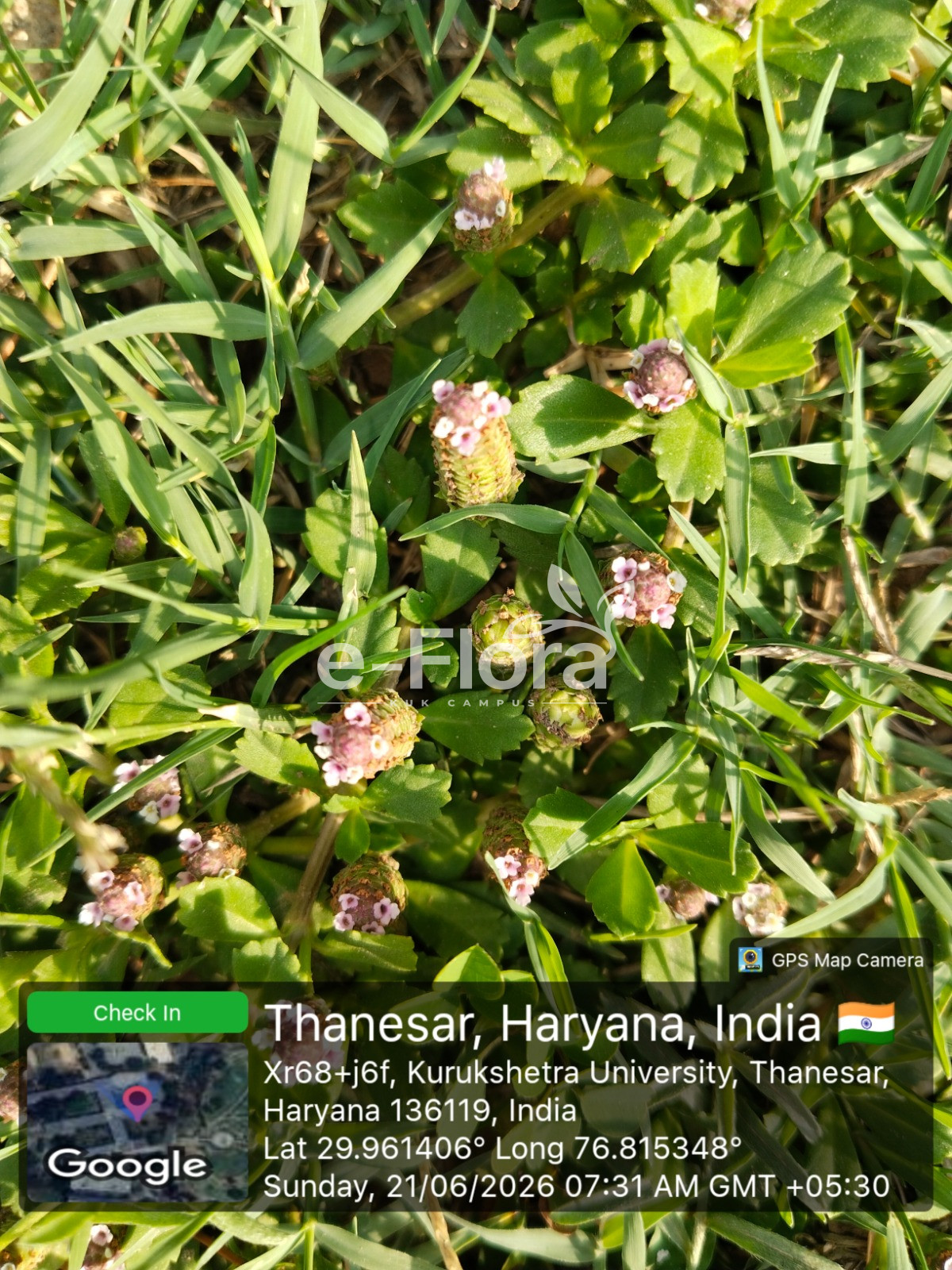
Phyla nodiflora (L.) Greene
Vernacular name: Frog Fruit, Turkey Tangle, Jal Pippali (Hindi: जल पिप्पली)
Species Name: Phyla nodiflora (L.) Greene (syn. Lippia nodiflora (L.) Michx.)
Family: Verbenaceae
Habit: Perennial creeping herb.
Stem: Prostrate, slender, branched, rooting at the nodes, glabrous to sparsely pubescent.
Leaf: Opposite, spatulate to obovate, 1–4 × 0.5–2 cm, serrate towards the apex, short-petiolate.
Flowering: Throughout the year, especially during the rainy season.
Flowers: Small, white to pale pink or lilac with a yellow throat, densely arranged in axillary cylindrical to globose heads; corolla tubular, 4-lobed; stamens 4; ovary superior, bicarpellary.
Fruit: Small dry schizocarp splitting into two one-seeded nutlets.
Uses:
- Tropical application of poultice or paste of crushed leaves helps to treat minor ulcers, boils, cuts, burns, wounds and swollen glands.
- Traditional medicines uses infusions of leaves for mild indigestion and postpartum recovery.
- Folk practices used extracts of leaves on scalp to ease irritation, itching and to remove dandruff.
- Plant cooling property is used in traditional practices to reduce fever, inflammations, treat urinary disorders and relieve joint pains.
- Commonly used as a ground cover as can tolerated heavy foot traffic and for erosion control because of its creeping, mat-forming habit.
- It also serves as a nectar source for butterflies, bees and other pollinators.