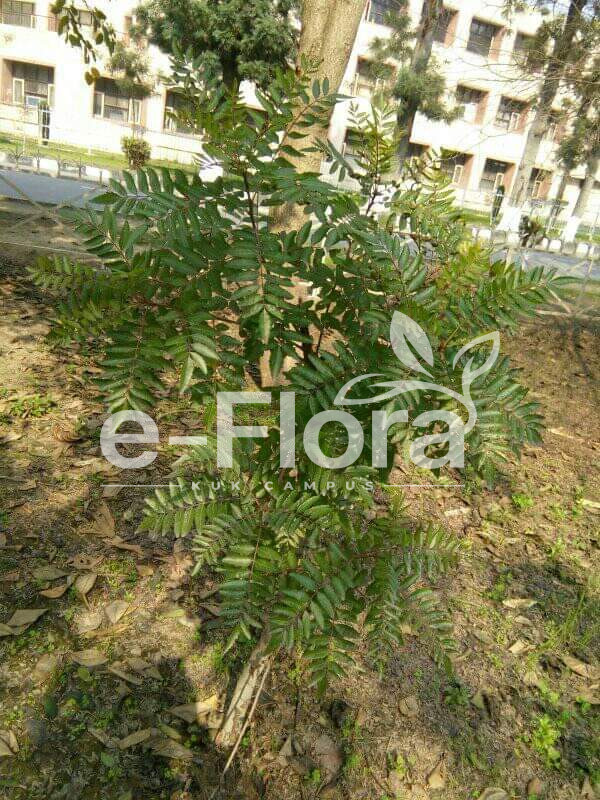
Boswellia serrata Roxb. ex Colebr.
Vernacular name: Indian Frankincense, Salai, Salai Guggul (Hindi: सालई, सलई गुग्गुल)
Species Name: Boswellia serrata Roxb. ex Colebr.
Family: Burseraceae
Habit: Medium-sized deciduous tree.
Stem: Straight to irregular trunk 8–18 m tall; bark thin, papery, greenish-grey to ash-coloured, exfoliating in thin flakes; resinous.
Leaf: Alternate, imparipinnate, 15–45 cm long; leaflets 8–15 pairs, ovate-oblong, serrate, pubescent when young, clustered near branches end.
Flowering: Winter–spring (January–April).
Flowers: Small, creamy-white, borne in axillary racemes; petals 5, free; stamens 10, inserted on a nectar disc; ovary superior, 3-carpellary.
Fruit: Trigonous ovoid capsule, about 1–1.5 cm long, 3-valved, containing winged seeds.
Uses:
- Plant is used to help relieve knee pain, stiffness and osteoarthritis linked swelling.
- Plant block or reduce synthesis of leukotriene and help in reducing asthma symptoms and wheezing.
- Ailments such as Crohn’s disease and ulcerative colitis can be treated using this plant as it can soothe bowel inflammations.
- Herbal medicines uses plant in creams and ointments to soothe skin irritation and speed up wound healing.
- Plant can be helpful in breast cancer and leukemia and prevent loss of cartilage.
- Guggul has analgesic property too.
- The tree yields salai guggul (Indian frankincense, an essential oil), an aromatic resin widely used in Ayurveda (Shallaki), incense, perfumery, and religious ceremonies.
- Wood is used for light construction, paper pulp, plywood, and matchsticks.
- Plant can cause mild nausea, acid reflux, diarrhea, skin rashes and minor stomach problems.