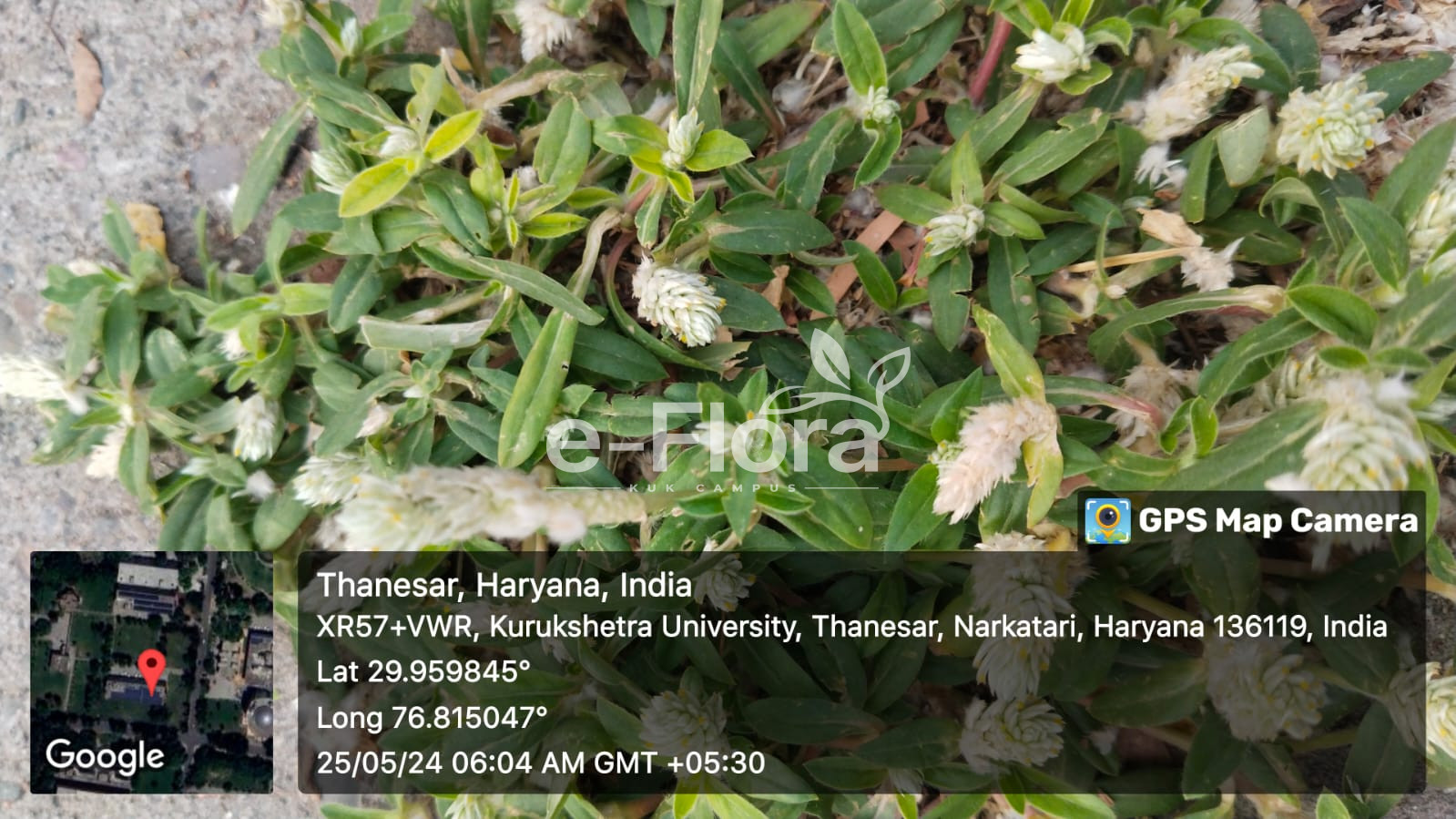
Gomphrena serrata L.
Vernacular name: Prostrate Gomphrena, Coastal Globe Amaranth (Hindi: रुद्राक्षी)
Species Name: Gomphrena serrata L.
Family: Amaranthaceae
Habit: Annual herb, prostrate to ascending, commonly occurring as a weed in wastelands, roadsides, and open fields.
Stem: Slender, much-branched, decumbent to ascending, rooting at lower nodes, sparsely hairy.
Leaf: Opposite, elliptic to obovate, 1–4 × 0.5–2 cm, entire, shortly petiolate, glabrous to sparsely pubescent.
Flowering: Throughout the year under favourable conditions.
Flowers: Small, white to pinkish, densely packed into globose heads; flowers bisexual with 5 papery tepals, 5 stamens, and a superior ovary. Inflorescence terminal and axillary globose heads (capitula-like clusters) on slender peduncles.
Fruit: Small indehiscent utricle, enclosed by the persistent papery perianth, containing a single seed.
Uses:
- Extracts from plant is used by traditional healers to alleviate general body pain, inflammations and as carminatives.
- Traditional healing system uses all parts of the plant to treat diarrhea, piles, bronchial asthma, allergies, dermatitis, diabetes and hay fever.
- Plant is found to have anti-inflammatory, antioxidant, antimicrobial, anthelmintic, analgesic, anticancer and hepatoprotective properties.
- It is a common plant can be found in lawns, roadsides, open sandy areas and as weed in some crop fields.
- If plant is ingested by livestock animals, it can affect their nervous system and cause coordination issues.