

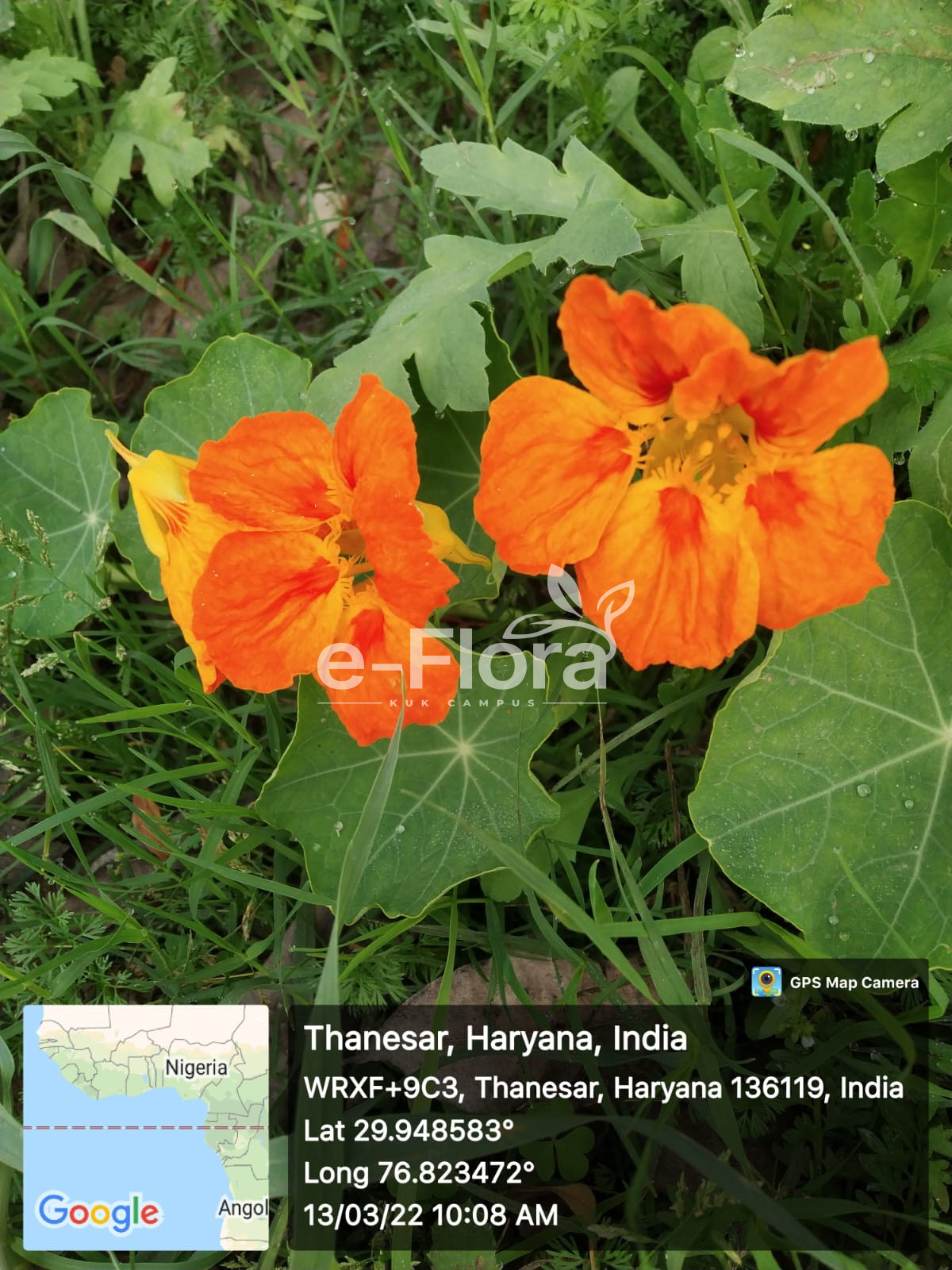
Tropaeolum majus L.
Vernacular name: Nasturtium, Garden Nasturtium, Indian Cress
Species Name: Tropaeolum majus L.
Family: Tropaeolaceae
Habit: Annual, trailing or climbing herb
Stem: Soft, succulent, weak, trailing or climbing
Leaf: Alternate, nearly circular and peltate, entire or shallowly lobed; long petiole; veins radiating from the point of petiole attachment
Flowering: Mainly during the favourable growing season
Flowers: Large, showy, brightly coloured (yellow, orange, red); zygomorphic; 5 sepals, with one forming a prominent nectar spur; 5 petals; 8 stamens. Solitary, axillary flowers.
Fruit: Fleshy schizocarp, splitting into 3 one-seeded segments.
Peculiar features: Peltate shield-like leaves and solitary, conspicuous, spurred flowers are the most characteristic features. The family is particularly distinguished by its axillary showy flowers, noticeable spur and 8 stamens.
Uses:
- Traditional practices uses infusions of leaves to ease coughs, clear bronchial catarrh, treat mild respiratory infections like bronchitis and cold.
- Plant contains an active compound benzyl isothiocyanate that acts as a natural diuretic and antiseptic for urinary tract and helps against bacterial infections. It can aldso be useful in treating digestive and respiratory bacterial infections.
- Traditionally, poultices of crushed leaves are used as antiseptic wash for minor wound and skin eruptions.
- It is an ornamental plant, planted in hanging baskets, balconies, borders and as ground cover.
- All parts of this plant are edible and have a peppery flavor. Flowers are rich in vitamin C and lutein (antioxidant) are used as salad garnish while leaves can be used in salads or blended in pestos. Unripe seed pods are pickled in seasoned vinegar.
- This plant is used in pest management as it attracts aphids and other pests away from vulnerable vegetables.
- Bright flowers are rich in nectar and attracts bees and other beneficial pollinators.