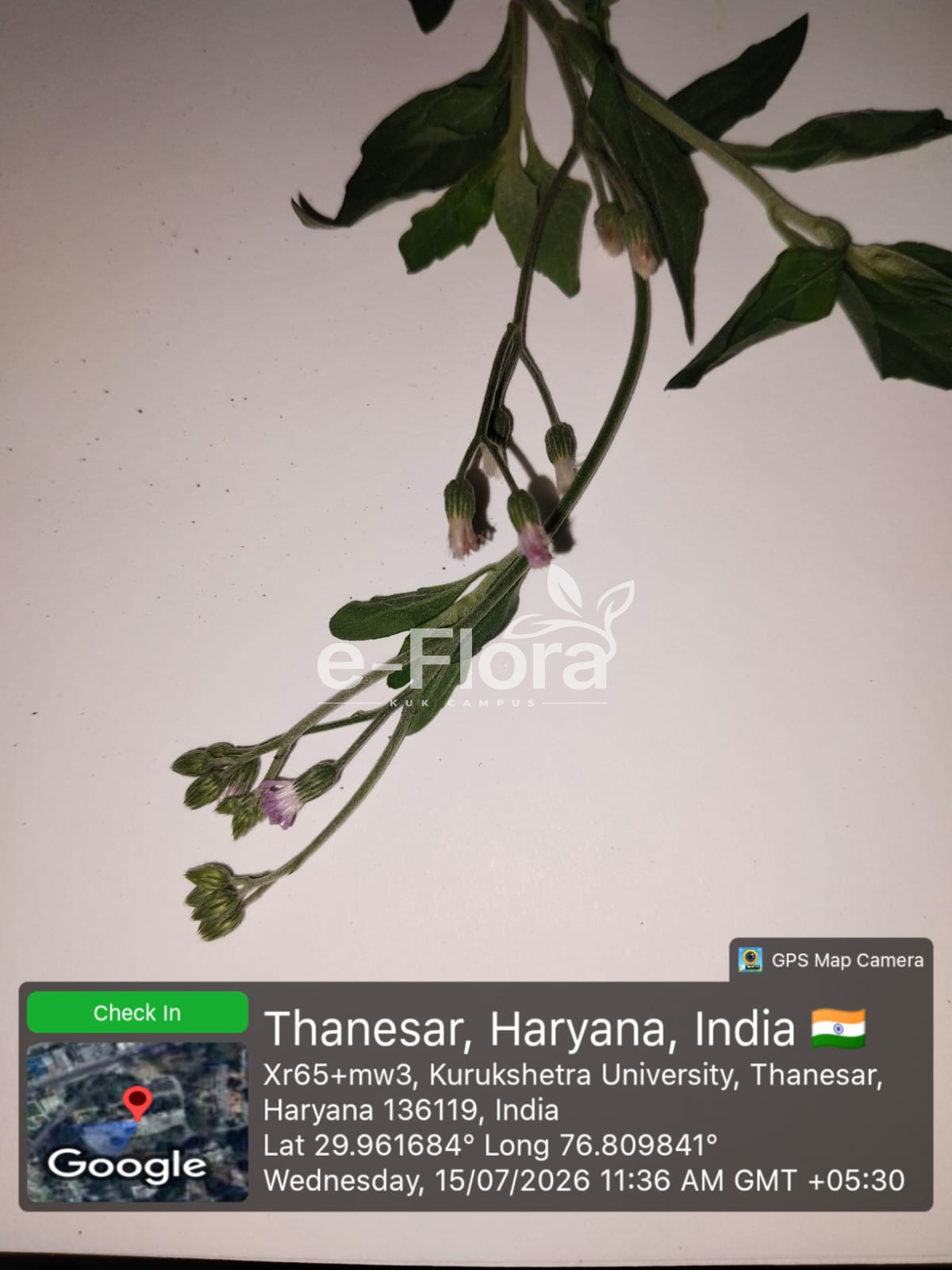
Emilia sonchifolia (L.) DC.
Vernacular name: Lilac Tasselflower, Cupid’s Shaving Brush (Hindi: सदाबहार जंगली, लाल भंगरा)
Species Name: Emilia sonchifolia (L.) DC.
Family: Asteraceae
Habit: Annual erect herb.
Stem: Slender, branched, glabrous to sparsely hairy, 20–70 cm tall, containing milky sap.
Leaf: Lower leaves rosulate, lyrate to obovate, petiolate; upper leaves alternate, sessile, lanceolate to ovate, amplexicaul, margins entire to sinuate.
Flowering: Throughout the year, chiefly during the rainy season.
Flowers: Capitula terminal, cylindrical; florets all bisexual, tubular, pink, lilac, purplish-red or rarely orange; involucre of a single series of green bracts; ovary inferior.
Fruit: Narrow cylindrical cypsela, ribbed, bearing a white pappus of numerous fine bristles.
Uses:
- Poultices or paste of crushed leaves are externally applied to treat boils, wounds, cuts and insect bites.
- Folk practices uses roots and aerial parts in treatment of dysentery, diarrhea and intestinal worm infection.
- Fresh leaves are crushed to extract juice that is used as eye drops for eye inflammations, conjunctivitis and night blindness or as ear drops for earaches.
- Leaf powder or decoctions helps to soothe and treat cough, cold, asthma, sore throats and intermittent fevers.
- Plant is used in the treatment of infantile tympanites and bowel ailments.
- Plant can be used to manage blood sugar levels in combination with Justicia secunda.
- Plant has astringent, diuretic, febrifuge, sudorific, depurative, antioxidant, antidiabetic, anti-inflammatory, hepatoprotective and expectorant properties.
- Flowers have properties to protect teeth from decay.
- Young leaves and shoots are harvested before flowering and are consumed raw in salads or as a leafy vegetable in some regions. It is also used as a fodder herb and attracts pollinating insects.
- Powdered plant is used to prepare Marcha, a Nepali cake fermented with yeast from which liquor is distilled.