Petunia × atkinsiana (Sweet) D.Don ex W.H.Baxter
Vernacular name: Petunia, Garden Petunia, Common Petunia
Species Name: Petunia × atkinsiana (Sweet) D.Don ex W.H.Baxter (Syn. Petunia × hybrida)
Family: Solanaceae
Habit: Annual or short-lived perennial herb, usually erect, spreading
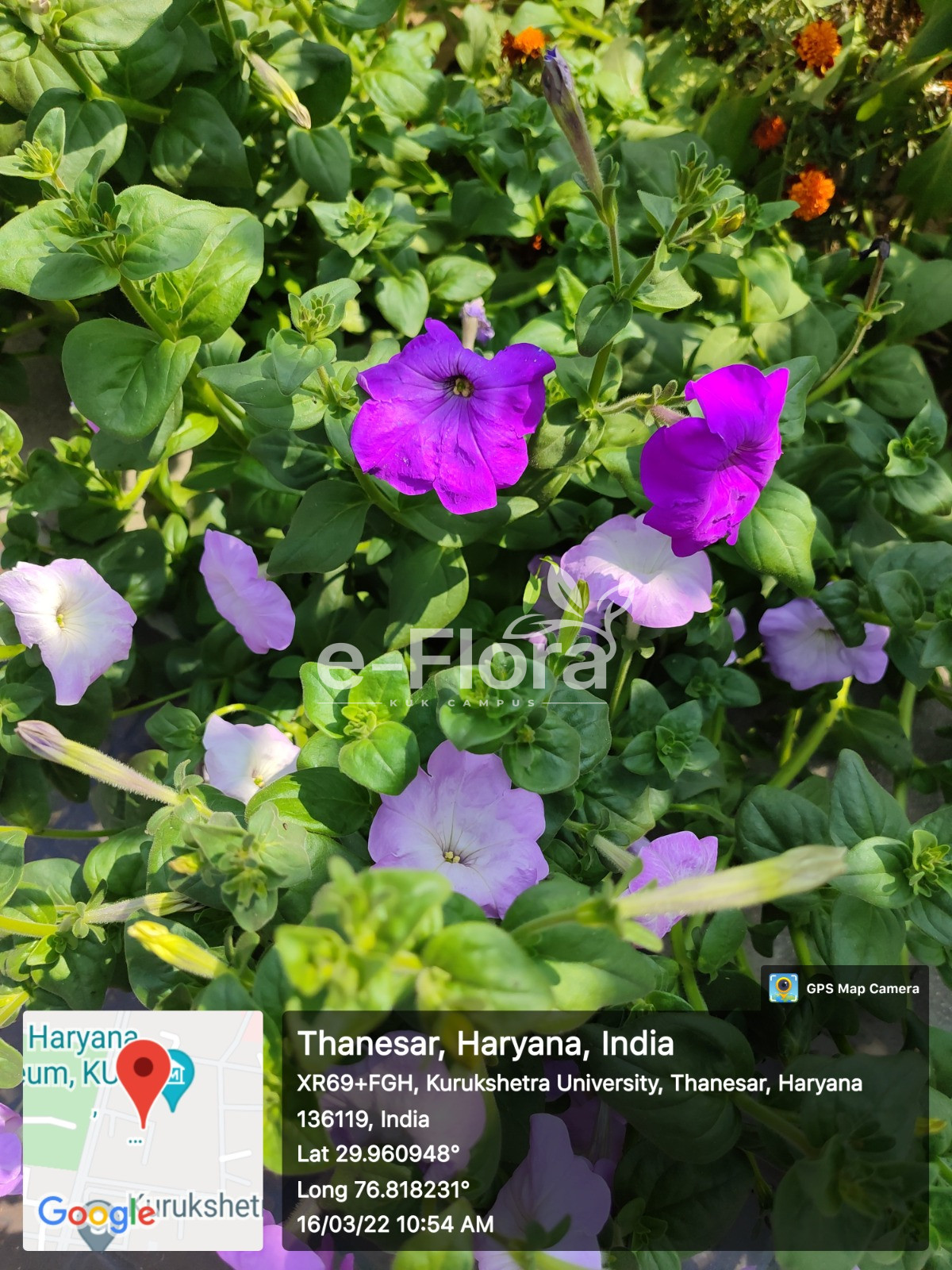
Stem: Soft, herbaceous, green, branched and usually covered with sticky glandular hairs; stems may become somewhat trailing
Leaf: Alternate, simple, ovate to elliptic or ovate-lanceolate, entire, green and slightly fleshy; usually shortly petiolate or nearly sessile and covered with glandular hairs.
Flowering: February–April
Flowers: Large, showy, bisexual and funnel-shaped, occurring in a wide range of colours including purple, violet, pink, red, white and bicolours. The corolla has a long tubular portion and a broad 5-lobed limb. Flowers are generally solitary and axillary, borne on individual pedicels rather than in a dense cluster.
Fruit: Two-valved capsule, containing numerous very small seeds
Uses:
- It is an ornamental plant widely planted in borders, flower beds, groundcovers and mass colour display. Its cascading and mounding varieties can be planted in window boxes, hanging pots and near patios.
- Plant has a distinct smell that along with its sticky foliage repels pests like leafhoppers and aphids. Whereas, nectar rich flowers attracts pollinators like bees, hummingbirds and butterflies.
- Flowers have a mild flavor and can be consumed raw in salads or can be used to garnish food.