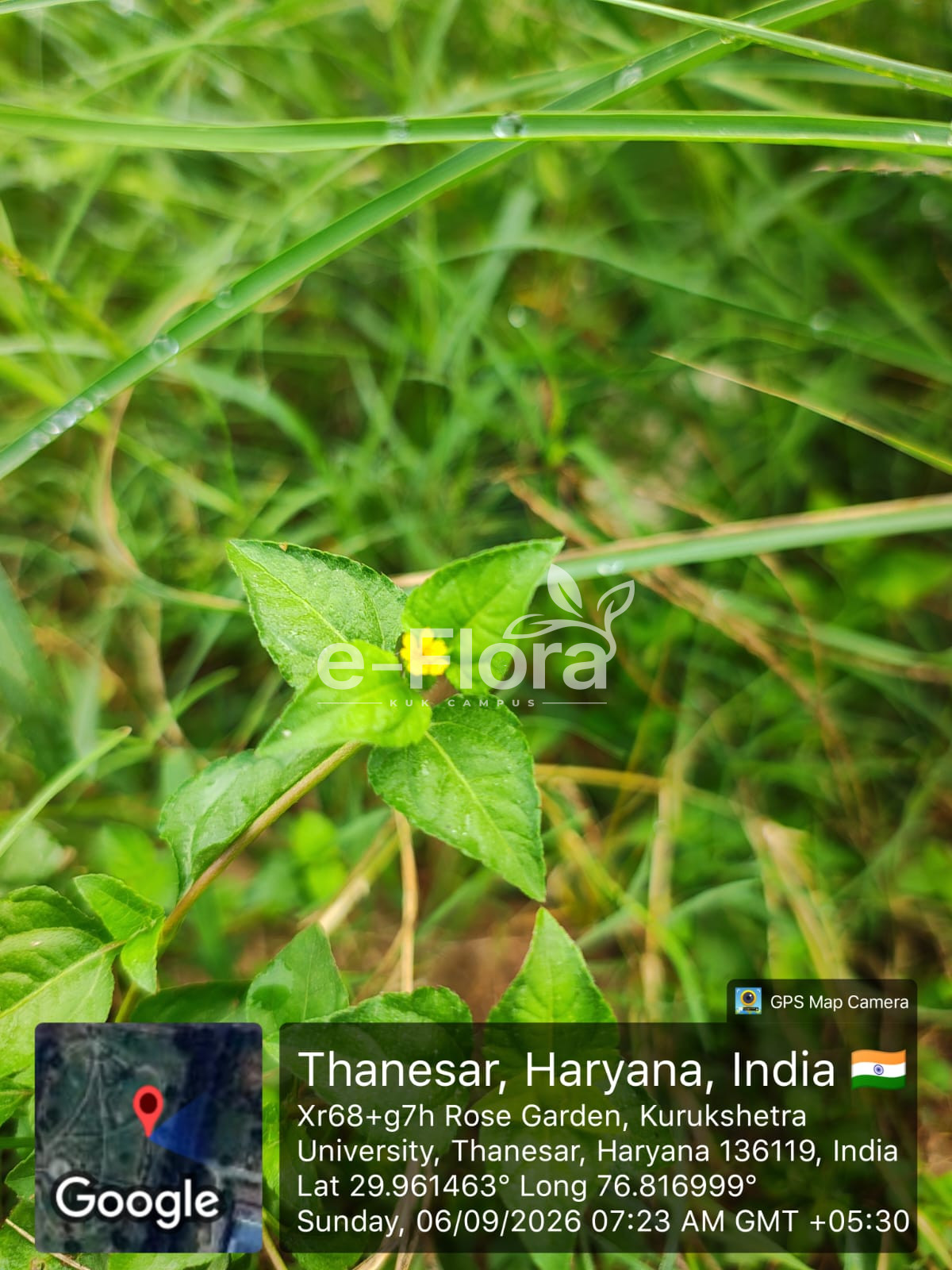
Calyptocarpus vialis Less.
Vernacular name: Straggler daisy, Prostrate lawnflower, Horseherb
Species Name: Calyptocarpus vialis Less.
Family: Asteraceae
Habit: Perennial, prostrate to decumbent, mat-forming herb, often rooting at nodes.
Stem: Slender, cylindrical, branched, hairy, prostrate to ascending.
Leaf: Opposite, ovate to broadly lanceolate, 2–5 × 1–3 cm, serrate, hairy on both surfaces, faintly 3-nerved from base.
Flowering: Throughout the year.
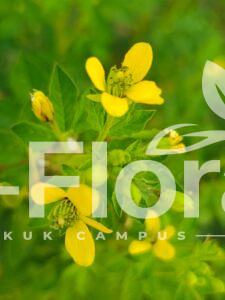
Flowers: Small solitary capitula, usually on slender peduncles; ray florets 3–8, pale yellow; disc florets numerous, yellow; involucre with 4 bracts in two whorls.
Fruit: Cypselae small, with 2 divergent awns; ray cypselae without wings.
Uses:
- Folk practices of northeaster Mexico uses the boiled stem and leaves infusion as washes to treat skin rashes.
- Plant is found to have anti-inflammatory, antidiabetic, antimicrobial and wound healing properties.
- Mainly a wild, rapidly spreading lawn and disturbed-ground weed, sometimes used as a ground-covering plant. It is primarily important botanically as a naturalized weed in India.
- Plant id drought tolerant and need very little water and mowing, so planted in gardens where it forms soft ankle high green mat, in rocky gap and in between stepping stones. Plant can also tolerate heavy foot traffic and grow in shady places where most grasses fail to grow.
- Dense and creeping roots of plant helps with preventing soil erosion, so can be planted on slopes and near river banks.
- Tiny yellow flowers attracts bees, butterflies and skippers for nectar.
- Phytochemical extracts of plant acts as green bio-based corrosion inhibitors for metal coatings.