
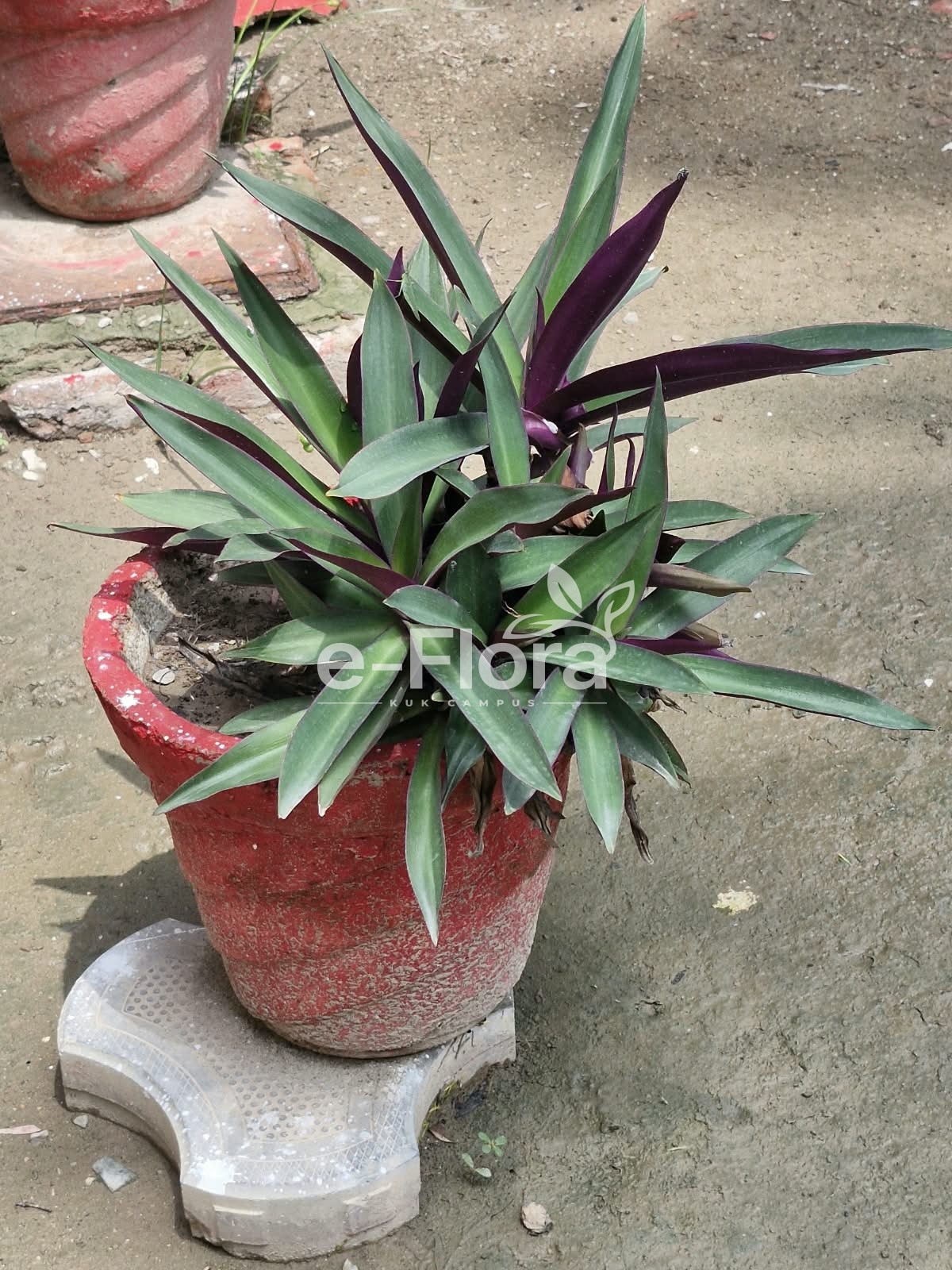
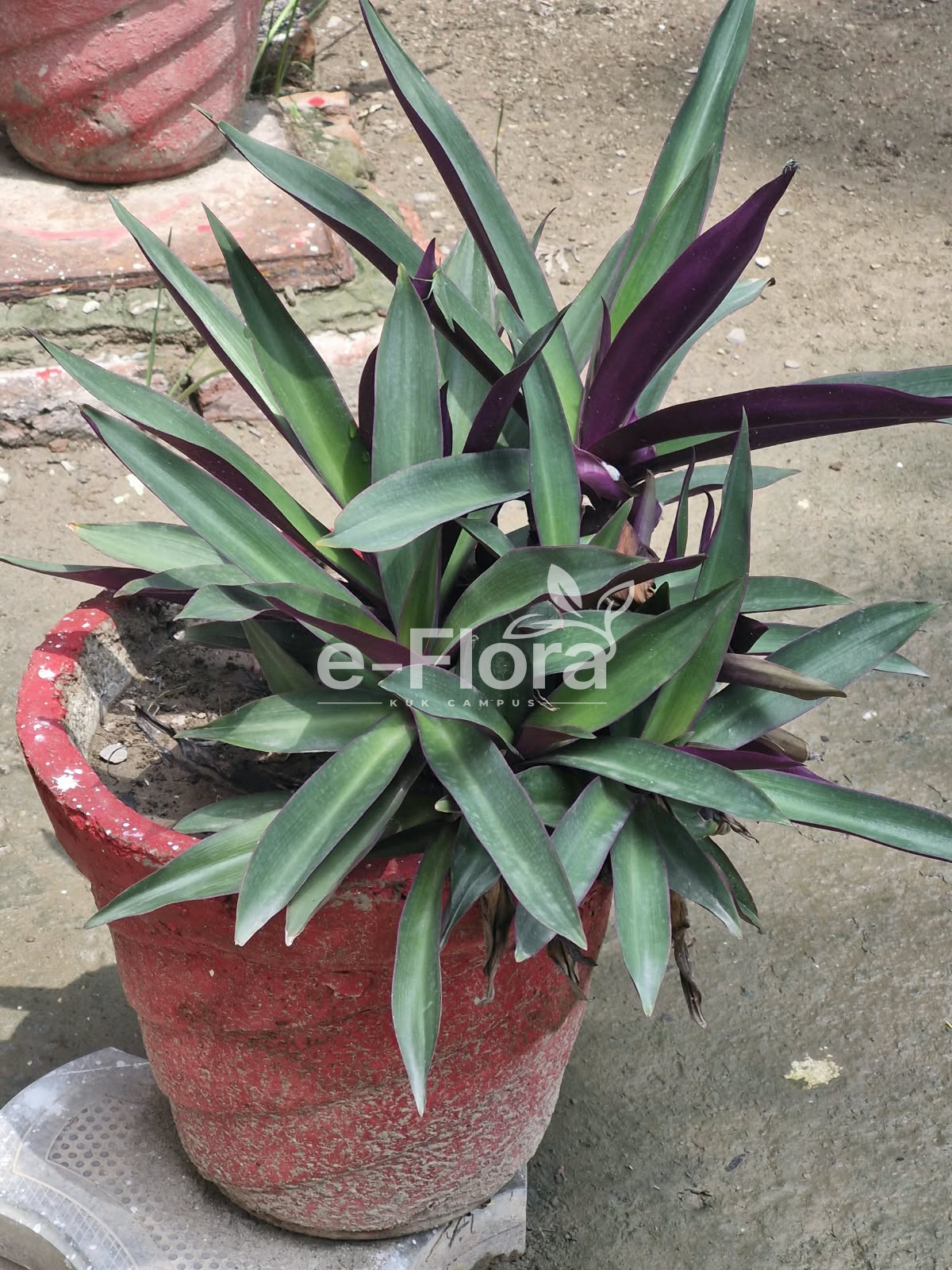
Tradescantia spathacea Sw.
Vernacular name: Boat Lily, Oyster Plant, Moses-in-the-Cradle, Rhoeo
Species Name: Tradescantia spathacea Sw. (syn. Rhoeo spathacea (Sw.) Stearn; Rhoeo discolor (L’Hér.) Hance)
Family: Commelinaceae
Habit: Perennial, succulent herb forming dense colonies.
Stem: Short, erect to ascending, succulent, usually simple, becoming elongated and decumbent with age.
Leaf: Alternate and spirally arranged, forming a dense rosette; oblong-lanceolate, about 20–40 × 3–6 cm, entire, fleshy, glabrous, dark green above and characteristically purple beneath; base sheathing.
Flowering: Almost throughout the year under favourable cultivation.
Flowers: Small, white, bisexual, arranged in dense axillary umbel-like clusters enclosed by two large, overlapping, boat-shaped bracts; sepals 3, petals 3, stamens 6 with bearded filaments; ovary superior, usually 3-locular with one ovule per locule.
Fruit: Small, 3-valved capsule, about 3–4.5 mm long, containing usually one seed per locule.
Uses:
- Leaves and flowers brewed into infusions and herbal teas to treat bronchitis, coughs and sore throats.
- Tropical applications of poultice or extracts are useful in soothing cuts, swellings and minor skin burns.
- Folk remedies uses plant for its diuretic properties to treat fevers, dysentery and renal ailments.
- Plant has anti-inflammatory, diuretic and anti-muscarinic properties.
- Calcium oxalate present in sap can cause skin irritation and mouth pain.
- Its vibrant purple- green foliage makes it a popular ornamental planted as boarders and flowerbeds in garden or in hanging baskets or pots indoor.
- Plant is valued for its drought-tolerant quality.