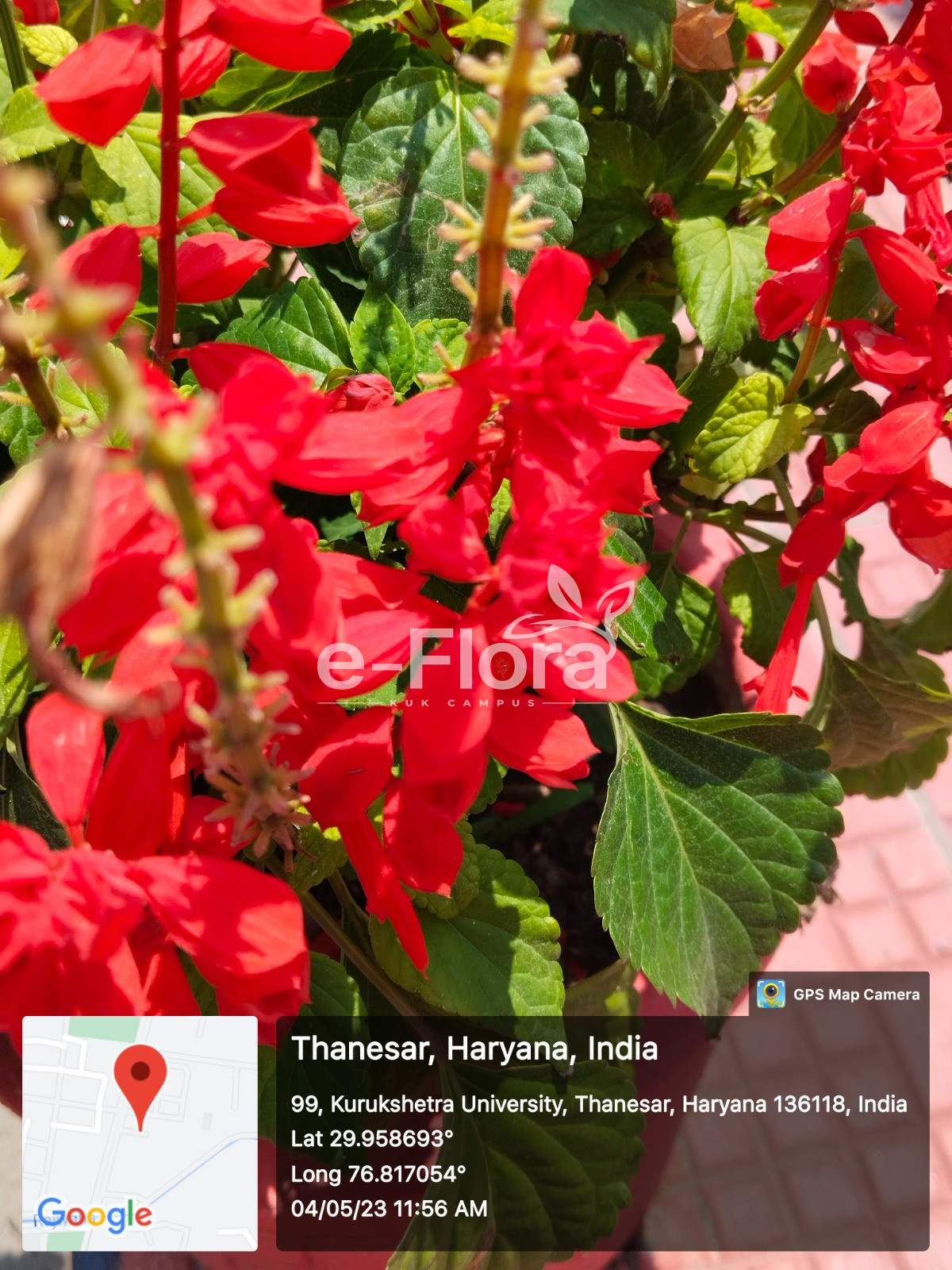
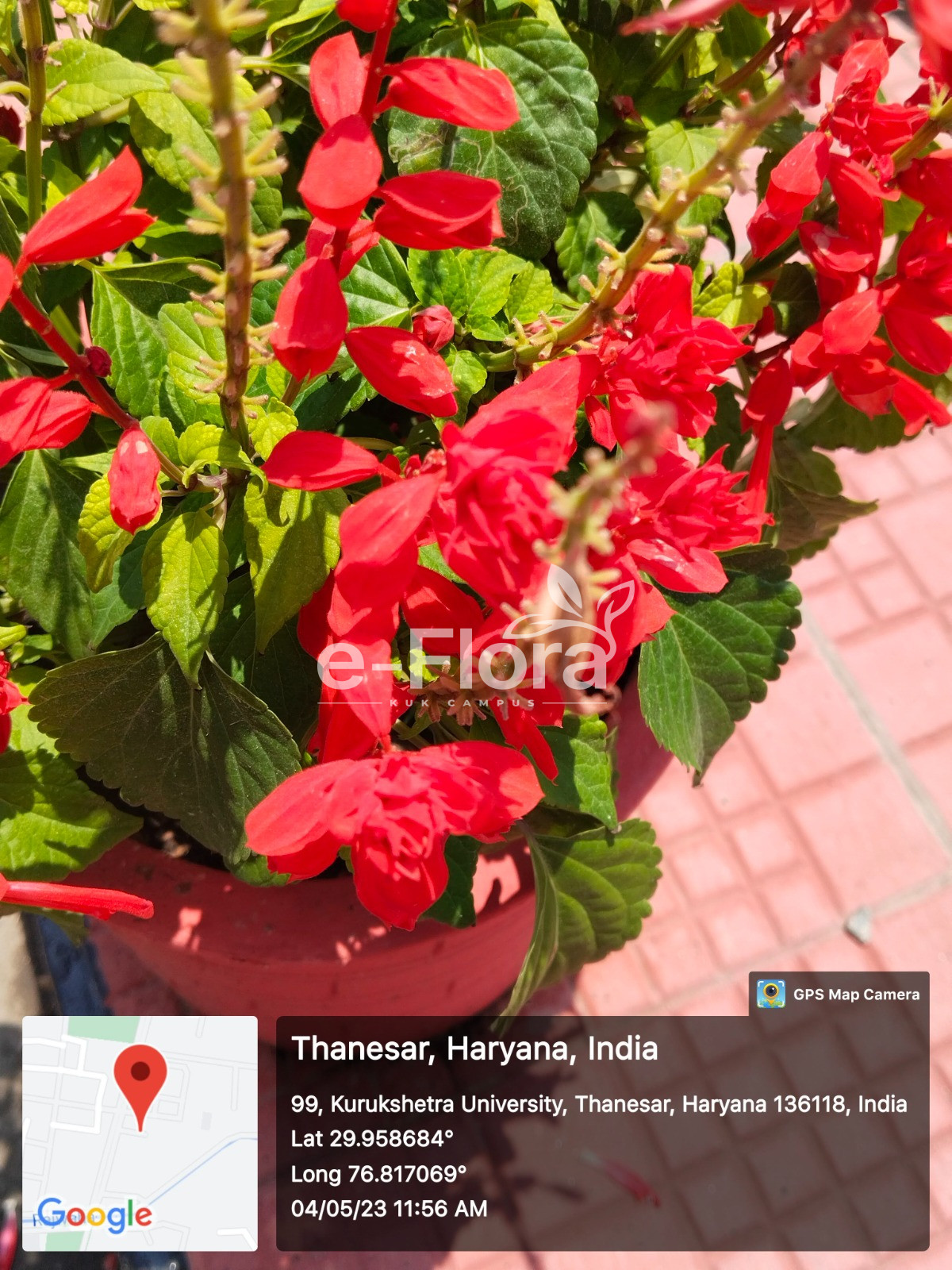
Salvia splendens Sellow ex Schult.
Vernacular name: Scarlet Sage, Red Salvia
Species Name: Salvia splendens Sellow ex Schult.
Family: Lamiaceae
Habit: Annual or short-lived perennial herb.
Stem: Erect, quadrangular, branched, glabrous to sparsely pubescent, 30–90 cm tall.
Leaf: Opposite, ovate to cordate-ovate, 4–10 × 2–6 cm, crenate-serrate, glabrous, long-petiolate.
Flowering: Throughout the year under cultivation, mainly winter–summer.
Flowers: Bright scarlet-red (also pink, white, purple, or salmon in cultivars), arranged in terminal racemes; calyx tubular, bilabiate; corolla bilabiate, 3–5 cm long; stamens 2; ovary superior, deeply 4-lobed.
Fruit: Dry schizocarp splitting into four small dark brown nutlets.
Uses:
- In traditional and regional medicines, decoction and poultices of different parts of plant is used to soothe skin irritation, heal wounds and treat minor ailments.
- Plant has anti-inflammatory, antidiabetic and antioxidant properties.
- In herbal practices, plant is used to treat cold, cough and congestion.
- One of the most popular bedding ornamentals, grown for its long-lasting, brightly red coloured flower spikes. Frequently planted in borders, mass plantings, pots, and public landscapes. Flowers attract bees, butterflies, and other pollinators.