
Trianthema portulacastrum L.
Vernacular name: Horse Purslane, Desert Horse Purslane, Bishkhapra (Hindi: विषखपरा / सबुनी)
Species Name: Trianthema portulacastrum L.
Family: Aizoaceae
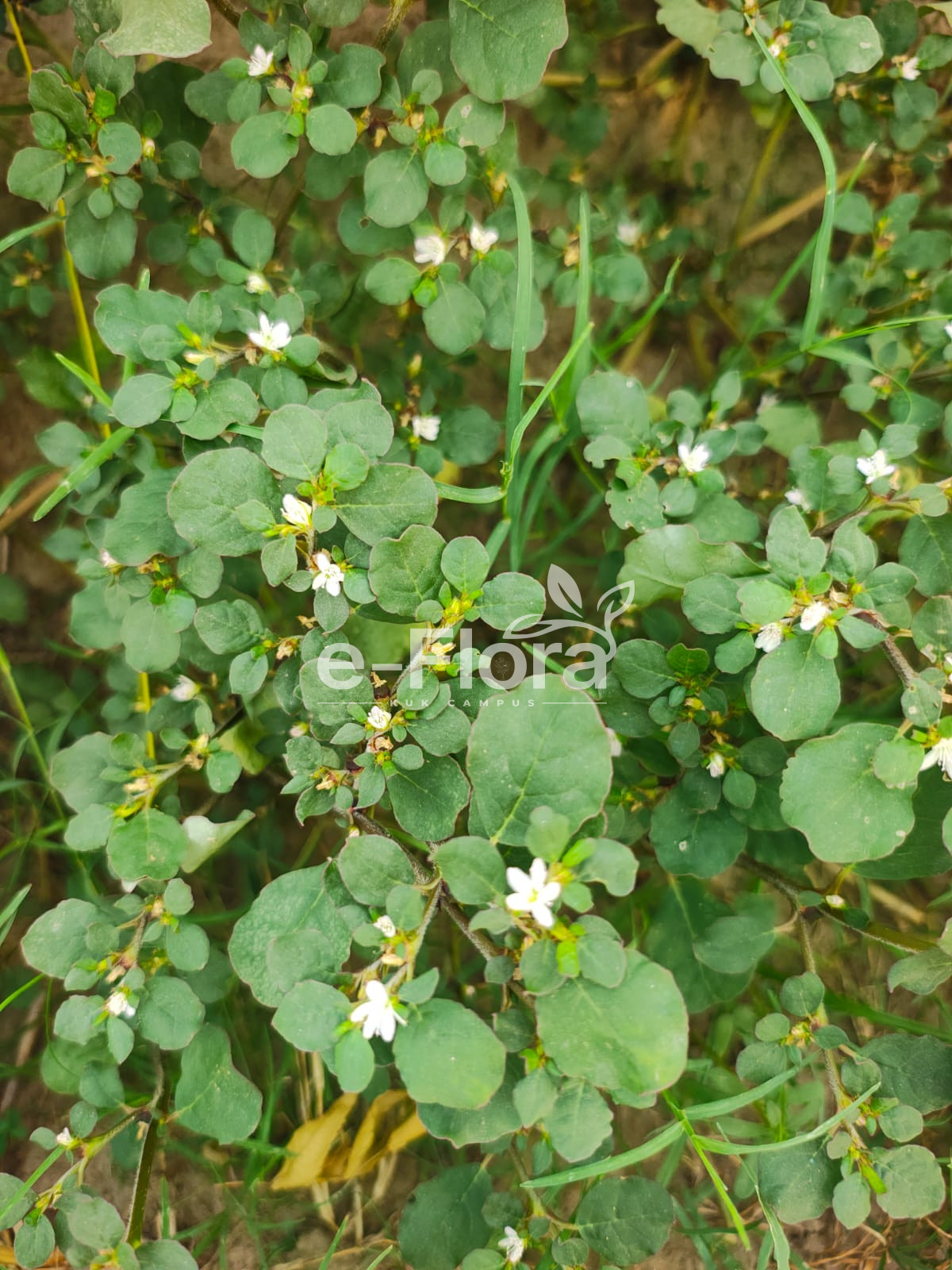
Habit: Prostrate to ascending, succulent annual herb.
Stem: Much-branched, diffuse, fleshy, prostrate or ascending, smooth to sparsely pubescent, up to about 50 cm long.
Leaf: Opposite but unequal, obovate to spathulate, 1–3 × 0.5–2 cm, entire, fleshy, obtuse; petioles broadened and united at the base into a sheathing cup.
Flowering: Mainly July–December in India.
Flowers: Small, solitary, sessile, axillary and partly hidden by the leaf bases; perianth 5-lobed, pink internally and whitish to pink externally; stamens usually 10–20; ovary superior, with a single style.
Fruit: Small, circumscissile pyxidium (lid-like capsule), dehiscing transversely and containing several seeds.
Uses:
- In Ayurveda, plant is used as stomachic, analgesic and mild laxative to treat pain, internal inflammations and swellings.
- Decoctions of roots and leaves are used to reduce edema, clear liver obstruction and relive jaundice-like symptoms.
- Plant acts as a traditional antidote and remedy for alcohol poisoning and helps against intestinal worms.
- External application of crushed leaves and seed paste helps to heal ulcers, sores and cuts.
- The plant has traditional use as a diuretic and in remedies for oedema and some liver and urinary complaints, though such medicinal uses should not be considered clinically established.
- Young leaves are eaten as a green vegetable in parts of India. It is also a common weed of cultivated fields, fallow land, and disturbed habitats.