Roystonea regia (Kunth) O.F.Cook
Vernacular name: Royal palm, Florida royal palm
Species Name: Roystonea regia (Kunth) O.F.Cook
Family: Arecaceae
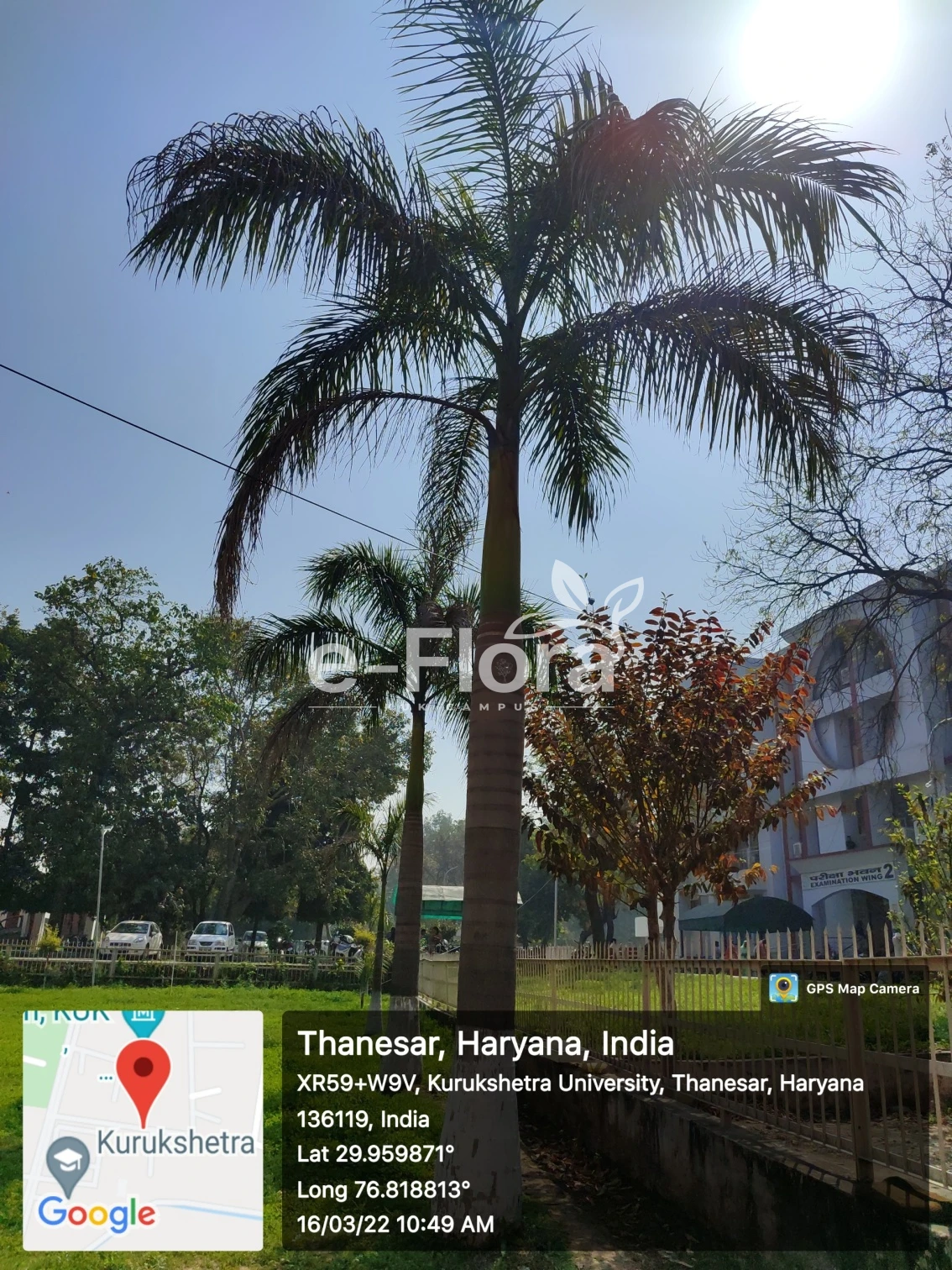
Habit: Tall majestic evergreen palm
Stem: Smooth silvery-grey trunk with basal bulge, green crownshaft.
Leaf: Pinnate fronds in dense crown, arching from smooth green crownshaft
Flowering: Spring-Summer (March-July)
Flowers: Large branched panicles emerging from crown shaft; tiny creamy-white bisexual flowers with pinkish anthers; 3 sepals, 3 petals, 6 stamens
Fruit: Ellipsoid black drupes
Uses:
- Fruit extracts treat prostatic hyperplasia and prostatitis whereas leaf has peroxidase enzyme applications.
- Bark has diuretic properties and used for managing diabetes.
- Leaf sheath is fibrous and used for thatching and as composite material.
- Wood can be used in furniture making and construction.
- Caribbean native (Cuba/Florida) and is national tree of Cuba that is planted tropically.
- Planted in moist hammocks as salt and wind tolerant and seeds are bird-dispersed.
- “King of palms”; symbolizes majesty; Cuban/ cultural icon.
- Iconic avenue and street tree planted in parks, estates, golf courses; self-cleaning (heavy falling fronds).
- Fruit and seeds are used to extract vegetable oils and due to nutrient content also used as fodder for livestock animals.