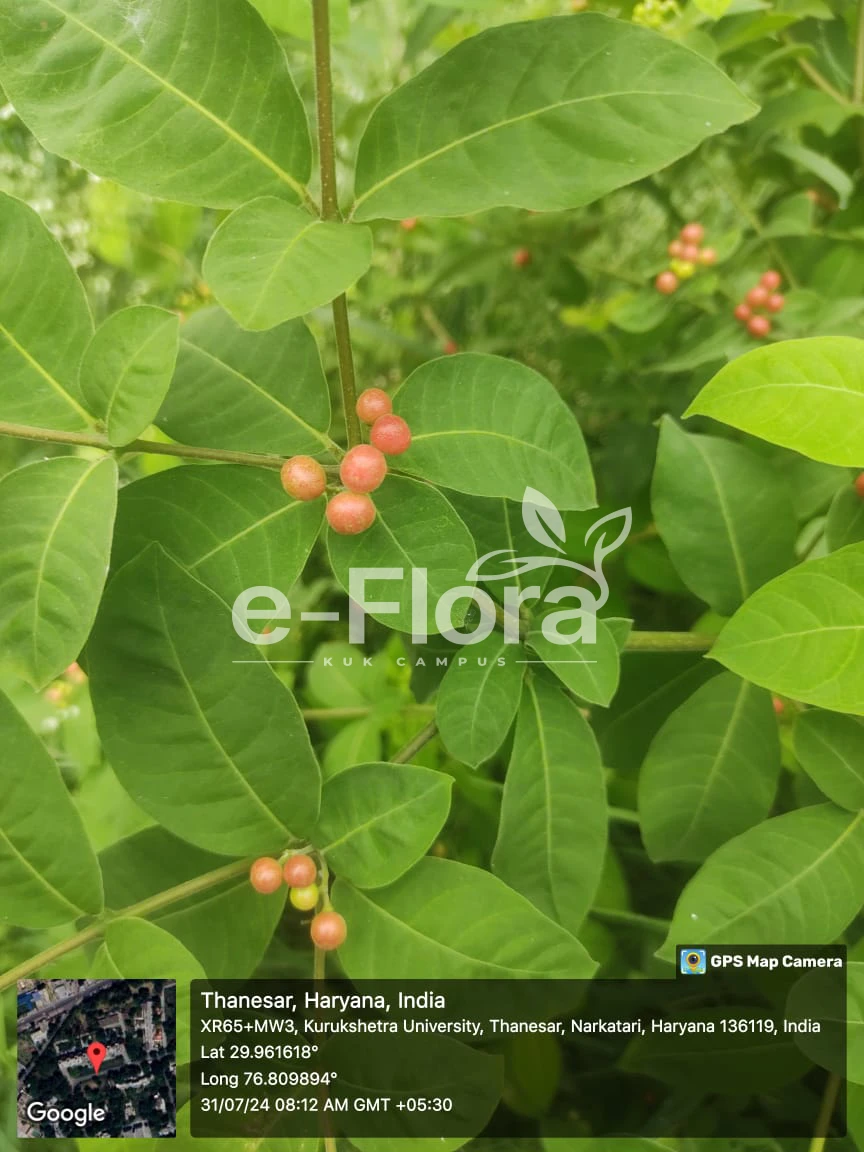
Rauvolfia tetraphylla L.
Vernacular name: Devil Pepper, Be-Still Tree (Hindi: जंगली सर्पगंधा)
Species Name: Rauvolfia tetraphylla L.
Family: Apocynaceae
Habit: Evergreen shrub
Stem: Erect, much-branched, 1–4 m tall; bark grey-brown, smooth; latex present.
Leaf: Whorled, usually in 4’s (sometimes 3–5), elliptic to obovate, 6–18 × 2–8 cm, entire, glabrous, shortly petiolate.
Flowering: Nearly throughout the year, chiefly spring–autumn.
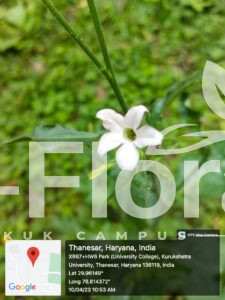
Flowers: Small, white to greenish-white, borne in terminal or axillary cymes; corolla salverform with 5 contorted lobes; stamens 5, epipetalous; ovary superior, bicarpellary.
Fruit: Drupe usually of two united lobes, globose, turning red and finally purplish-black at maturity; seeds 1–2.
Uses:
- Cultivated as an ornamental and medicinal shrub.
- Fruits are also attractive to birds.
- Plant also is a good natural insect repellent.
- Fruit is used to derive a black dye while juice is used as ink regionally.
- Roots contain indole alkaloids and are used in traditional medicine as a substitute for Rauvolfia serpentina, particularly for treatment of hypertension.
- Extracts with combination of oils are used for external application on wounds and a variety of skin problems.
- Root and leave paste is used in treatment of snake and poisonous bites where as extracts of roots and leaves are used manage fever, intestinal problems and nervous disorders.
- Allopathic medicines uses derivates like reserpine and deserpidine of plant to manage blood pressure.
- In some regions, plant is used for treatment of malaria also.
- Latex has cathartic, emetic, diuretic and expectorant properties.
- Plant has antipsychotic, antihypertensive and tranquilizing properties and help with insomnia.