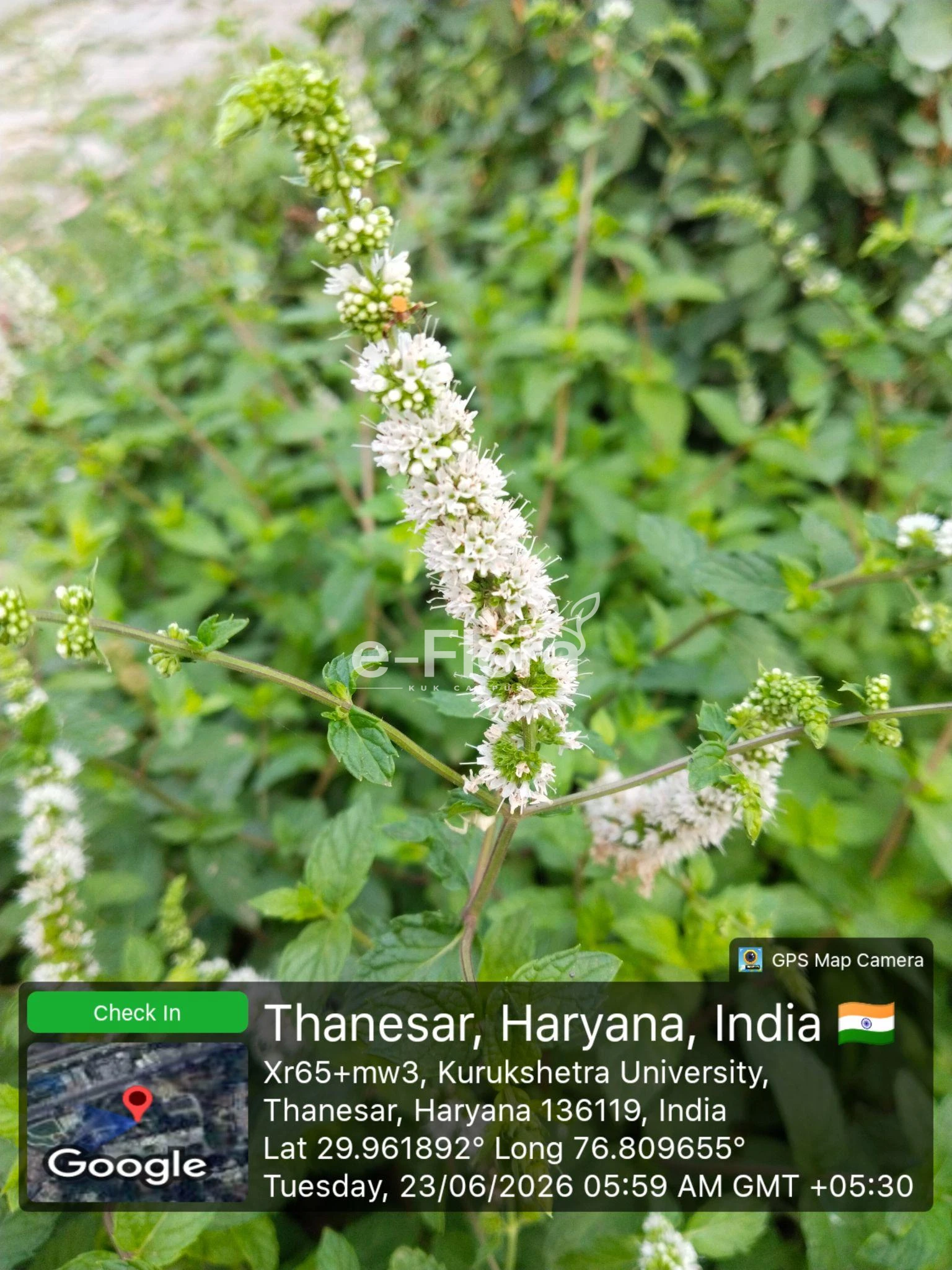
Mentha spicata L.
Vernacular name: Spearmint, Pudina (Hindi: पुदीना)
Species Name: Mentha spicata L.
Family: Lamiaceae
Habit: Perennial aromatic herb.
Stem: Erect to ascending, quadrangular, branched, glabrous to sparsely pubescent, arising from creeping rhizomes.
Leaf: Opposite, lanceolate to ovate-lanceolate, 3–9 × 1–3 cm, serrate, aromatic, short-petiolate.
Flowering: Summer–autumn.
Flowers: Small, lilac, pinkish, or white, arranged in dense terminal spikes; calyx tubular, 5-toothed; corolla bilabiate, 4-lobed; stamens 4, didynamous; ovary superior, deeply 4-lobed.
Fruit: Dry schizocarp splitting into four smooth nutlets.
Uses:
- Widely cultivated as a culinary herb and flavouring agent in beverages, chutneys, salads, and confectionery.
- Leaves yield spearmint oil rich in carvone, used in pharmaceuticals, cosmetics (lotions and lip balms), oral-care products, perfumery and candles.
- Dried or fresh leaves are used in salads, sauces and teas whereas spearmint oil is used to flavor chewing gums, candies, toothpastes and jellies.
- These essential oils can also be used in aromatherapy to alleviate stress.
- Traditionally plant can be used as carminative and mild medicinal herb to aid digestion, reduce nausea, improve memory and balance hormones and acts as anti-inflammatory agents.