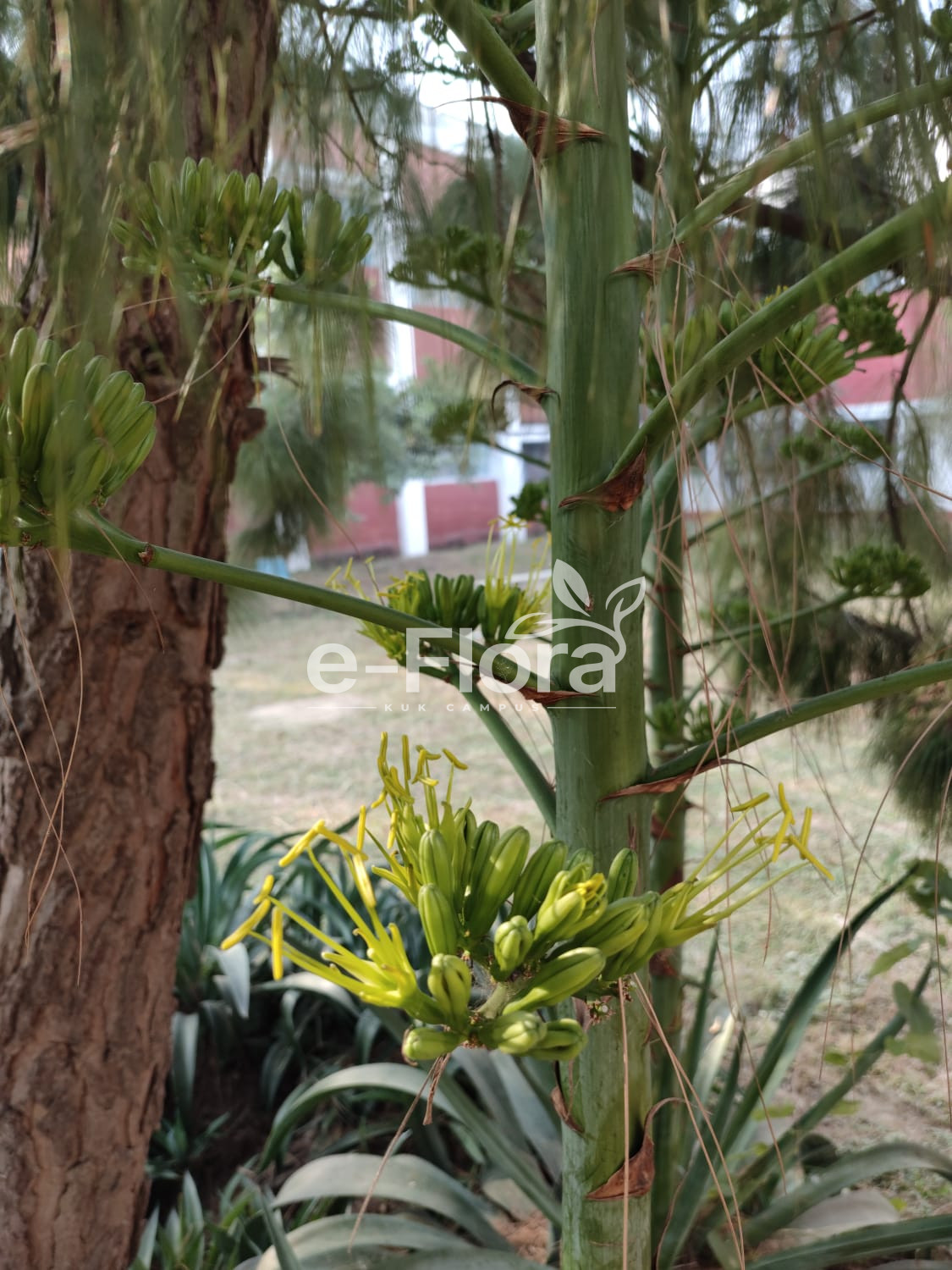
Agave americana L.
Vernacular name: Century plant, American aloe, Gawar patha (Hindi: ग्वारपाठा)
Species Name: Agave americana L.
Family: Asparagaceae
Habit: Massive rosette succulent perennial
Stem: Short thick trunk or acaulescent; offsets freely.
Leaf: Basal rosette, rigid fleshy lanceolate 1-2 m long × 15-25 cm wide, glaucous blue-green, spiny margins, terminal spine 3-6 cm.
Flowering: After 10-30 years
Flowers: Massive terminal paniculate raceme 6-12 m tall (huge paniculate inflorescence – branched raceme with thousands of flowers); greenish-yellow tubular 8 cm long.
Fruit: Capsule 4-6 cm, black seeds.
Uses:
- Folk medicines, uses poultices of sap and crushed leaves to treat wounds, boils and skin irritations though precaution is need or sap can cause dermatitis. Leaf sap also has laxative, antiseptic and emmenagogue properties.
- Tribes used plant for its diuretic properties that help in treatment of diarrhea and dysentery.
- Roots can be used in the treatment of syphilis.
- Before flowering sweet sap (aguamiel) is gathered and fermented into pulque or distilled into mezcal.
- Flowers are rich in nutrients and are edible. Flower stalk can be consumed raw or roasted. Seeds can be grounded in flour and can be used as thickening agent for soups and broths or can be used to bake breads.
- Leaves can be used to extract tough fibers, called as pita, that can be used to manufacture mats, papers, ropes and coarse textiles.
- Indigenous people used spines of plant as needles and pins.
- It is an ornamental plant for xeriscapes and deserts. It is also known as Rajasthan boundary marker.
- It can be used as fence for cultivated crops as its spines can keep livestock away from crops.
- Plant is used in arid region for reclamation and soil stabilization.
- In traditional stories, it is known as “Century plant” myth.
- Plant contains saponins and can be used to make soaps.
- Dried flowering stems are used as waterproof thatch.