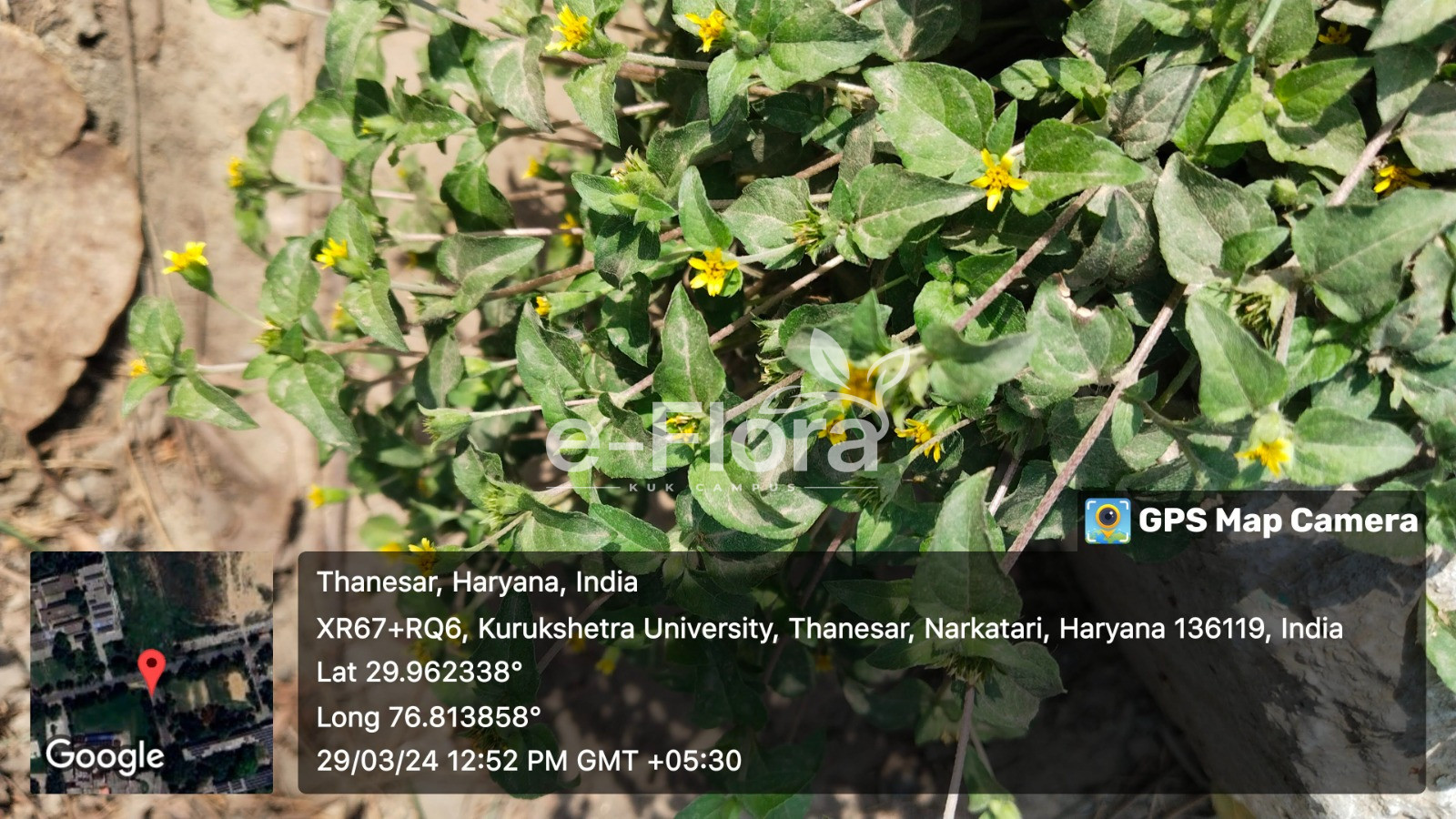
Sphagneticola calendulacea (L.) Pruski
Vernacular name: Chinese Wedelia, Creeping Ox-eye (Hindi: पीली भृंगराज)
Species Name: Sphagneticola calendulacea (L.) Pruski (syn. Wedelia chinensis (Osbeck) Merr.)
Family: Asteraceae
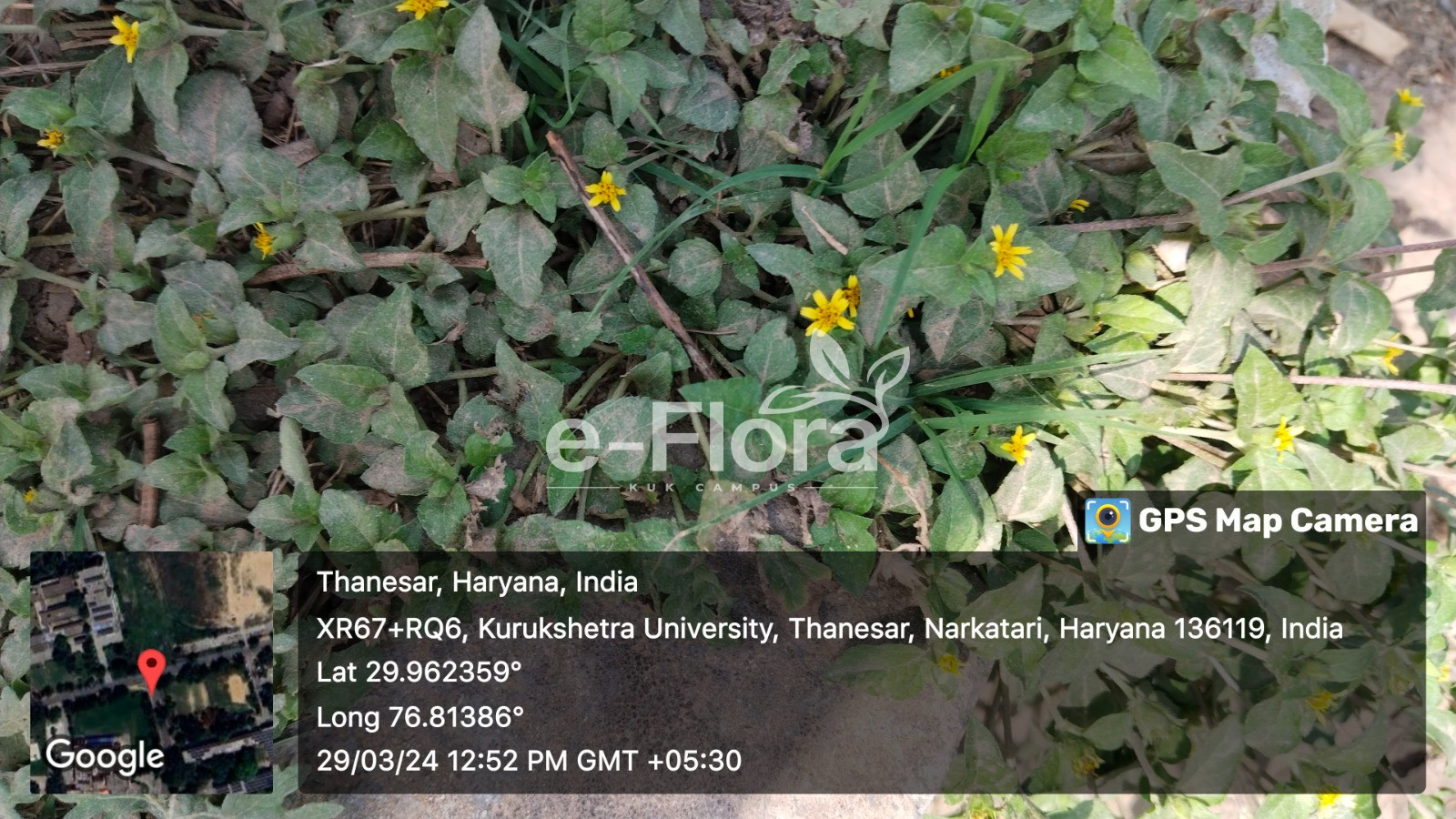
Habit: Perennial creeping herb.
Stem: Prostrate to ascending, succulent, branched, rooting at the nodes, glabrous to sparsely hairy.
Leaf: Opposite, sessile to short-petiolate, elliptic to lanceolate, 3–8 × 1–3 cm, serrate, glabrous to sparsely pubescent.
Flowering: Throughout the year.
Flowers: Solitary terminal or axillary capitula; ray florets yellow, female; disc florets yellow, bisexual; involucre of green phyllaries; ovary inferior.
Fruit: Small compressed cypsela, brown to black, crowned with minute scales or lacking a distinct pappus.
Uses:
- Widely used in traditional medicine for liver disorders, wound healing, inflammation, fever, and skin diseases. Commonly planted as an ornamental ground cover and for erosion control. The plant also provides nectar for bees and butterflies.
- In traditional practices, extracts and juice of fresh leaves are used to treat alopecia, promote hair growth and dye grey hair.
- Decoctions of crushed leaves and fresh juice are to bath infants to prevent skin infections and treat boils, ulcers, cuts, wounds, fungal infections, eczema, dermatitis and other minor skin ailments.
- Traditional remedies uses leaf juice as nasal snuff to relieve headaches and treat coughs and sore throats.
- Decoction of different parts of plant is used to treat jaundice, enlarged spleen, menorrhagia and uterine hemorrhages.
- Leaf juice is processed to yield a deep, indelible blue-black dye that can be used in tattooing, while roots with iron salt produces a black coloured dye.
- It is an ornamental plant due to its dense mats that can used to prevent soil erosion.
- Plant is an important ingredient for making a traditional cooling herbal tea known as Qingcao cha in China and Taiwan.